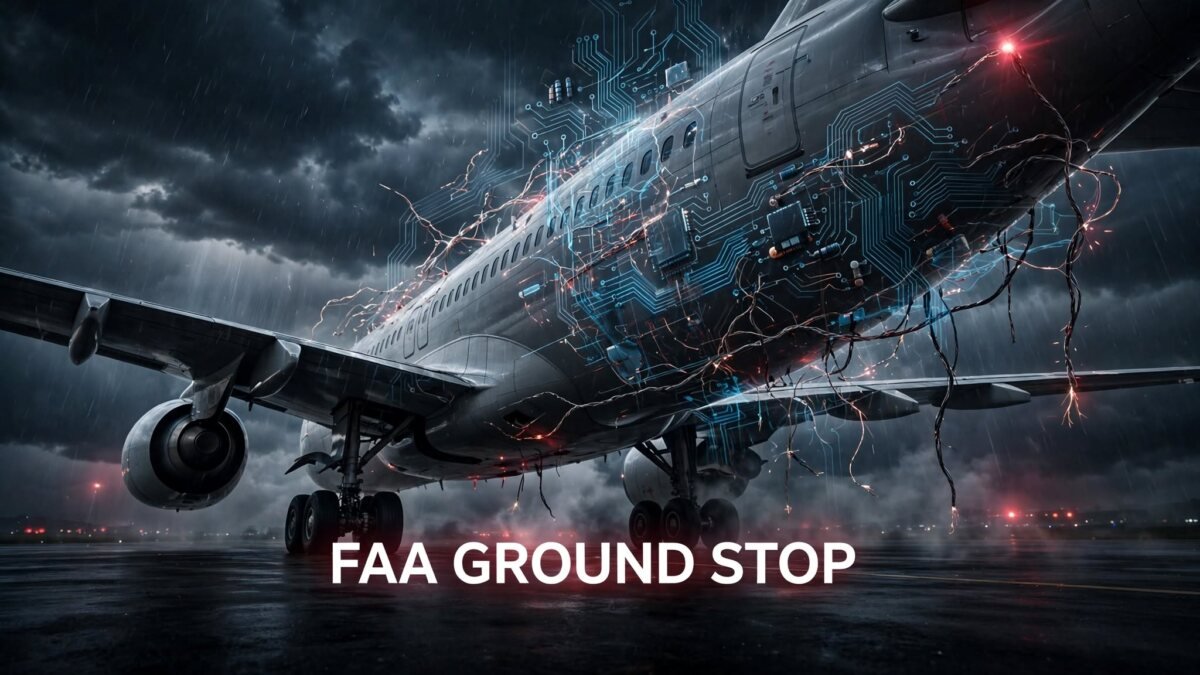
When a complex system built on decades-old technology finally buckles under pressure, the consequences are immediate and nationwide. That is exactly what happened to US aviation this week—and it was not because of AI.
On November 13, 2026, the Federal Aviation Administration (FAA) issued a rare nationwide ground stop, halting all departing flights across the United States for approximately four and a half hours. More than 1,900 flights were canceled and over 10,000 delayed as a result.
The initial speculation—amplified across social media and some news reports—pointed to the FAA’s newly deployed SMART AI system as the culprit. That speculation was wrong.
What Actually Caused the Ground Stop
Transportation Secretary Sean Duffy was explicit: the failure was caused by “old technology”—specifically, analog telecommunications equipment and routers that became overloaded with data and began producing inconsistent information.
“We have analogue telecoms, our routers actually got overloaded with data … and they started to give us inconsistencies in the data … because of that we shut the system down,” Duffy said. “It is the old hardware that went down.”
Homeland Security Secretary Markwayne Mullin described it as a “telecommunications outage” and stated there was no indication of a cyberattack or nefarious activity.
The failure affected the 22 regional air traffic control centers that direct planes en route between airports nationwide. Without reliable communication between these centers and aircraft, the FAA had no choice but to ground departing flights as a safety precaution.
The AI Red Herring
The SMART (Strategic Management of Airspace, Routes and Trajectories) system had been fully deployed across all 22 air route traffic control centers just days before the outage, on November 10. That timing fueled speculation that the new AI tool was responsible.
It was not.
AirSpace Intel, the contractor behind SMART, issued a direct statement: “The current ground stop is not based on or a result of the SMART system, any product of ASI or our integration with FAA and ATC.”
Crucially, SMART operates from a single location near Washington, D.C., and only provides recommendations to air traffic controllers—it does not control communications infrastructure or aircraft routing directly. Controllers retain the authority to accept or reject its suggestions.
The system had been operating since September 21 and had reportedly helped reroute 180 flights, saving an average of 10 minutes and nearly 80 gallons of fuel per flight. Whatever its long-term merits or risks, it did not cause this outage.
The Real Vulnerability: Decades of Underinvestment
The ground stop exposed a more fundamental problem: the FAA’s air traffic control infrastructure is dangerously old.
Much of the hardware and software in use dates back to the 1980s and 1990s. Congress approved $12.5 billion last year to begin modernizing the system, replacing copper wires with fiber optics and upgrading radio systems. But Duffy has said another $30 billion is needed to complete the work.
This was the first nationwide ground stop since January 2023, when a key FAA computer system malfunctioned. Before that, the last comparable event was in the aftermath of the September 11, 2001 attacks.
What Happens Next
The FAA lifted the ground stop on the evening of November 13, but widespread cancellations and delays are expected to persist for days as airlines work to reposition aircraft and crews.
Congressional hearings are likely. Lawmakers from both parties have already been pressing the FAA on its modernization timeline and on the SMART system’s deployment—though those are separate issues. The October request from Democratic members of the House Transportation Committee for a GAO audit of SMART focused on its safety testing and controller training, not on any link to the communications failure.
BS Maurya Research Verdict
The FAA ground stop is a temporary crisis, but it exposes a permanent vulnerability: critical infrastructure built on aging technology is one failure away from systemic disruption.
The rush to blame AI was understandable but wrong. The SMART system may deserve scrutiny on its own merits—lawmakers have raised legitimate questions about testing and controller input—but conflating it with this outage distorts the real lesson. The United States did not ground thousands of flights because an AI model hallucinated. It grounded them because analog telecom equipment from another era could not handle the data load of modern aviation.
For investors in aviation and defense technology, the signal is clear: companies that provide stable, proven infrastructure—not flashy AI features—are the ones that matter when systems fail. The modernization contracts will be enormous, but the priority must be reliability over novelty.
For travelers, the message is simpler: the system is fragile, and the fixes will take years and tens of billions of dollars.
FAQ
Q1: What caused the FAA ground stop?
The ground stop was caused by a telecommunications outage affecting the 22 regional air traffic control centers. Transportation Secretary Sean Duffy attributed it to overloaded analog telecom equipment and routers producing inconsistent data.
Q2: Was the SMART AI system responsible?
No. AirSpace Intel, the contractor behind SMART, explicitly stated the ground stop was not caused by the AI system. SMART operates from a single location and only provides recommendations to controllers—it does not control communications infrastructure.
Q3: How many flights were affected?
More than 1,900 flights were canceled and over 10,000 delayed nationwide as of Friday evening. The ground stop lasted approximately four and a half hours.
Q4: Is it safe to fly now?
The FAA lifted the ground stop after determining the system was stabilized. However, residual cancellations and delays are expected for days as airlines recover.
Q5: When was the last nationwide ground stop?
The last nationwide ground stop was in January 2023, when a key FAA computer system malfunctioned. Before that, the last comparable event was after the September 11, 2001 attacks.