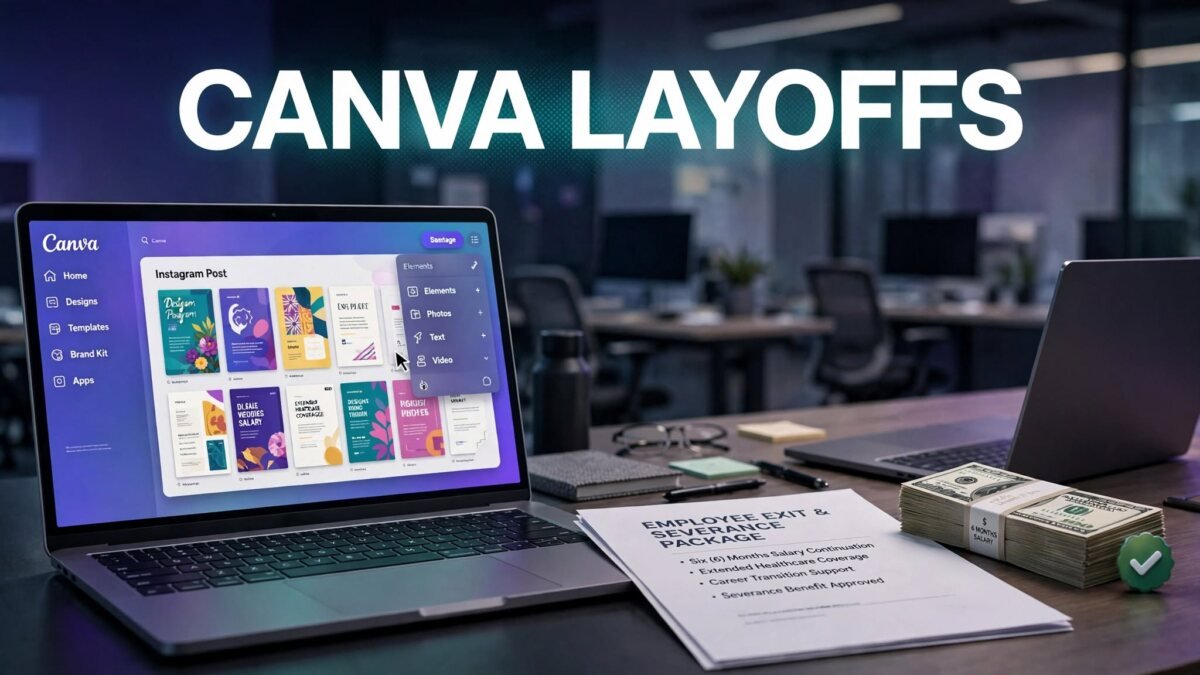
Canva, the Australian design platform used by hundreds of millions of people worldwide, has announced a major workforce restructuring that will affect 1,271 employees, representing approximately 22% of its workforce.
The announcement, made by co-founder and CEO Melanie Perkins on November 4, 2026, marks one of the most significant organisational changes in the company’s 13-year history.
But there is an important distinction: not all 1,271 employees are being laid off. Some will face changes to their existing roles, others may be asked to relocate to centralised hubs, while some employees will leave the company.
In her message to employees, Perkins described the decision as the hardest moment in Canva’s thirteen-year history.
What has attracted international attention, however, is the support Canva is offering to employees who are leaving. The company has outlined a severance package that includes at least six months’ salary, healthcare support, career assistance and even the option to keep company-issued MacBooks.
What Happened at Canva? Why Are 1,271 Employees Affected?
Canva says its organisational structure needs to change as the business enters its next phase of growth.
According to Perkins, the company has experienced slower growth for the first time in a decade. Its existing organisational structure had also become increasingly complex, with specialised teams, overlapping responsibilities and too many coordination layers.
The restructuring will involve combining Product, Growth and Platform teams into a more unified product organisation.
The company also plans to simplify management layers and bring more teams together in centralised locations.
Sydney will become a primary base for more product teams. From January 2027, most hybrid employees are expected to work from an office two to three days a week, depending on their team.
Canva is also investing in artificial intelligence and developing its own AI models. However, the company has clarified that the departing employees’ roles are not simply being replaced by AI.
The changes are therefore better understood as a combination of organisational restructuring, slower growth and a shift in the skills and operating model Canva needs for the future.
Canva’s Severance Package: What Will Departing Employees Receive?
The most talked-about part of Canva’s announcement is its support for employees who are leaving.
Instead of offering only a basic exit payment, Canva has outlined several financial, healthcare and career-transition benefits.
Here is what the departing employees can expect.
1. At Least Six Months of Salary
Every departing employee will receive at least six months of salary, inclusive of statutory entitlements, regardless of their location.
This is a minimum commitment rather than a fixed maximum. The actual amount may vary depending on individual circumstances and applicable employment entitlements.
For employees suddenly facing unemployment, this financial support can provide valuable time to find another job or plan their next move.
2. Employees Can Keep Their MacBooks
Canva has confirmed that departing employees can keep their company-issued MacBooks.
This is a particularly practical benefit because not everyone has a personal laptop available for job applications, interviews, freelance work or starting a business.
It also means employees can retain a useful work device while transitioning to their next opportunity.
3. Twelve Months of Healthcare Support
Departing employees will receive 12 months of continued healthcare coverage in countries where Canva currently provides this benefit.
The company is also extending access to Canva Care, its employee assistance programme, for 12 months.
This support also extends to family members covered under the programme.
The healthcare benefit is subject to availability in the relevant country and should not be interpreted as a universal benefit in every location.
4. One Year of LinkedIn Premium
Canva is providing departing employees with one year of LinkedIn Premium.
This can help former employees improve their professional profiles, connect with recruiters, explore job opportunities and make their search for a new position easier.
The company is also providing individual career coaching, CV support and interview preparation.
5. An Alumni Talent Directory
Canva is creating an opt-in alumni talent directory for employees who are leaving.
With their permission, departing employees can have their professional information included in a directory that Canva plans to share with investors, partners and industry contacts.
The idea is to use Canva’s professional network to help former employees find new opportunities.
6. A $10,000 Canva Collective Fund Grant
One of the most unusual parts of the package is the Canva Collective Fund.
The programme will offer $10,000 grants to eligible departing employees who want to launch a business or develop a community project.
Canva has said it will not seek equity or ownership in the businesses or projects supported through these grants.
However, this is an application-based opportunity, not an automatic $10,000 payment to every departing employee.
Interested employees have until December 14, 2026, to register their interest.
7. One-Year Vesting Cliff Waiver
Canva is also waiving the one-year vesting cliff for affected employees who joined within the previous 12 months.
Normally, employees with equity compensation subject to a one-year cliff may lose their unvested shares if they leave before completing that period.
By removing this cliff for the affected employees, Canva is offering them more favourable treatment of their equity awards.
This does not mean every employee automatically receives all future or unvested shares. The applicable equity arrangements and individual award terms still matter.
Why Is Canva Restructuring Despite Its Global Success?
Canva has become one of the world’s best-known online design platforms, serving hundreds of millions of users.
But rapid expansion can also create organisational complexity.
As companies grow, teams become more specialised, management layers increase and decisions may require coordination across several departments.
Canva’s leadership believes the business needs to return to smaller, more empowered teams with clearer ownership and faster decision-making.
Slower growth has added pressure to rethink how the company operates.
The company has also been investing heavily in AI-powered design tools and developing its own AI models. Its changing technology strategy means it needs to reassess the roles, skills and teams required for its next phase.
Importantly, Canva has not described AI as a direct replacement for the employees leaving.
What Happens Next at Canva?
Canva has scheduled a company-wide All Hands meeting for November 10, 2026, to discuss the restructuring, answer questions and explain the company’s future direction.
The organisation is also expected to simplify its internal structure, consolidate overlapping responsibilities and shift more product-related teams towards Sydney.
Most hybrid employees will face new office attendance expectations from January 2027.
Canva has not publicly specified exactly how many of the 1,271 affected employees will ultimately leave the company, as the restructuring also includes role changes and relocation requests.
The Bigger Lesson: How Companies Should Handle Layoffs
Canva’s restructuring highlights an important issue in the technology industry.
Companies may need to reduce costs, reorganise teams or change their business strategies. But the way they treat departing employees can have a lasting impact on their reputation.
A generous severance package cannot remove the uncertainty and emotional stress associated with losing a job.
However, financial support, healthcare continuity, career coaching and practical resources can make the transition less difficult.
For employees, Canva’s announcement is a reminder that severance benefits can vary significantly between companies and countries.
For startup founders and HR leaders, it offers an example of how a company can approach difficult workforce decisions while providing meaningful support to people affected.
FAQ
Q1: How many Canva employees are affected by the 2026 restructuring?
Canva has announced that 1,271 employees, approximately 22% of its workforce, will be affected. However, not all of them are necessarily losing their jobs. Some will face role changes or relocation requests.
Q2: What severance package is Canva offering departing employees?
Departing employees will receive at least six months’ salary, subject to statutory entitlements, 12 months of healthcare coverage where available, one year of Canva Care, LinkedIn Premium, career coaching and the option to keep their company-issued MacBooks.
Q3: Can former Canva employees keep their MacBooks?
Yes. Canva has confirmed that employees leaving the company can keep their company-issued MacBooks.
Q4: What is the Canva Collective Fund?
The Canva Collective Fund is a grant programme offering $10,000 to eligible departing employees who want to start a business or develop a community project. Canva will not take equity or ownership in these ventures. Interested employees have until December 14, 2026, to register their interest.
Q5: Why is Canva restructuring its workforce?
Canva has cited slower growth, organisational complexity and the need to reorganise its teams, responsibilities and required skills. The company is also changing how it develops and delivers its products.
Q6: Can departing Canva employees retain their shares?
Canva is waiving the one-year vesting cliff for affected employees who joined within the previous 12 months. This provides more favourable treatment of their equity awards, subject to the relevant individual award terms.
Q7: Is Canva replacing the 1,271 employees with AI?
Canva has clarified that the departing employees’ roles are not simply being replaced by AI. The restructuring is focused on organisational changes, team consolidation and the skills needed for the company’s future products.