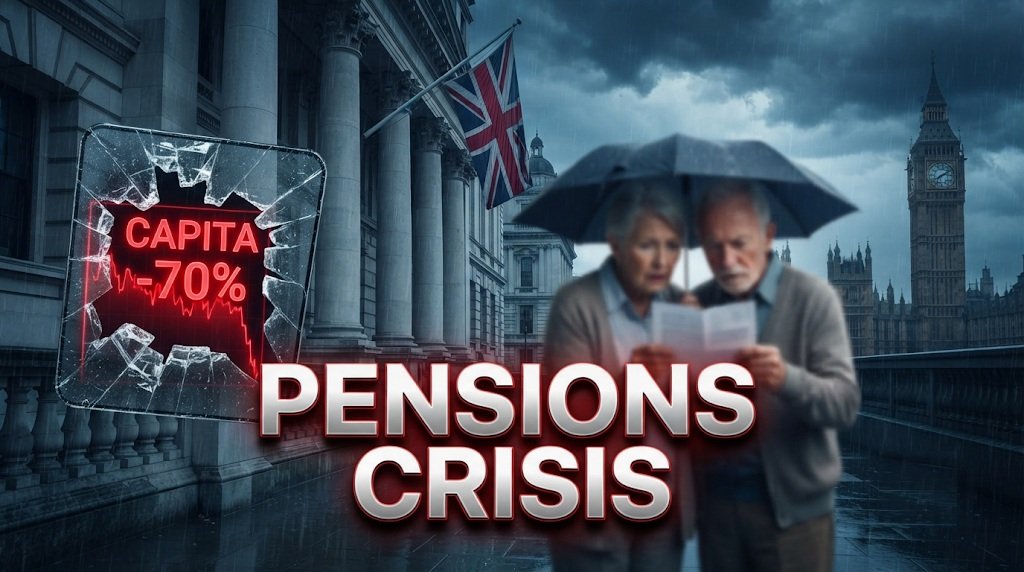
The Capita civil service pensions catastrophe has finally claimed its biggest scalp. Chief Executive Adolfo Hernandez stepped down with immediate effect on Monday as Capita’s shares collapsed more than 70% to 65.2p — a near 35-year low — following the company’s second profit warning in six months and a £190 million emergency equity raise to shore up its balance sheet. The outsourcing giant, which took over administration of the £239 million, 1.7-million-member Civil Service Pension Scheme in December 2025, has admitted it “has not delivered the service that members deserve”. For UK pensioners, the fallout is measured in missed mortgage payments and unprocessed bereavement claims. For investors, it is a case study in how a single government contract can destroy shareholder value in under twelve months.
How the Capita Civil Service Pensions Failure Unfolded
Capita won the Civil Service Pension Scheme (CSPS) contract in 2023, promising to “modernise pensions administration” with generative AI and digital tools. The contract went live on 1 December 2025. Within weeks, reports emerged of thousands of civil servants — some with decades of service — unable to access their pensions, lump sums miscalculated by 30%, and bereavement cases left outstanding for months.
The Parliamentary record is damning. In a November 19 debate, MPs detailed constituent cases including a Ministry of Defence employee who retired without his pension, a widow whose bereavement case remained unresolved six months after her husband’s death, and a retiree whose pension quotation took nine months and cost him £700 for a divorce valuation. The Cabinet Office has already withheld payments under the contract and imposed a five-workstream rectification plan overseen by remedial adviser Grant Thornton. The Public Accounts Committee has launched a formal inquiry, warning that “promises have been made and broken by Capita, to our faces”.
The Financial Fallout: £190M Cash Call and a 2027 Profit Warning
The numbers behind Monday’s market rout are brutal. Capita now expects 2027 adjusted operating profit to be £85 million to £95 million lower than previously guided, driven by the cost of the CSPS recovery plan (£15–25 million in 2027) and the loss of two other major contracts in defence and pension solutions. Net debt is forecast at around £300 million by year-end.
| Metric | Detail |
|---|---|
| Share Price (Nov 23) | 65.2p, down ~70% |
| 2027 Profit Hit | £85M–£95M reduction |
| Equity Raise Planned | £190 million (H1 2027) |
| CSPS Recovery Cost (2027) | £15M–£25M additional |
| Net Debt (Year-End Est.) | ~£300 million |
| CEO Exit | Adolfo Hernandez, immediate |
| Acting CEO | Pablo Andres (ex-CFO) |
The equity raise is a survival measure, not a growth initiative. Largest shareholder Oasis Management (15.2% stake) has indicated it will participate, but Capita’s shares have now shed more than 98% of their value since mid-2015. The company says it expects “material recovery from 2028 onwards” — a timeline that requires the CSPS crisis to be fully resolved and two lost contracts to be replaced.
The Human Cost: What the Backlog Actually Looks Like
Government recovery plan data from October 2026 paints a stark picture of the operational failure. As of 30 September, 1,311 bereavement cases were over 100 days old, alongside 332 death-in-service cases and 277 payment cases. Of the bereavement backlog, 1,049 were classified as “non-workable” because Capita required additional information from third parties — a bureaucratic dead-end for grieving families.
The Cabinet Office has confirmed it is “actively evaluating long-term options,” including insourcing the scheme. But ministers have resisted immediate termination, warning it could “trigger an operational vacuum and jeopardise monthly pension payments for hundreds of thousands of our public servants”. The trap is now clear: Capita is too failing to trust, but too embedded to fire overnight.
For UK retirees navigating pension delays, our Personal Finance section covers the escalation routes and compensation options available.
The Investment Question: Is Capita a Value Trap or a Turnaround?
At 65p, Capita trades at a fraction of its 2015 value. The bull case is simple: the CSPS contract is a finite problem, the rectification plan has government oversight, and the 2028 recovery target implies substantial upside for anyone buying at the bottom. The bear case is simpler: Capita has missed deadline after deadline, lost two other major contracts, and is asking shareholders for £190 million while its CEO walks out the door.
The UK government has already terminated Capita’s contract for administering the Royal Mail pension scheme earlier this year, as one MP noted in Parliament. If the Cabinet Office concludes that insourcing is the only viable path, Capita loses its largest remaining growth contract and the equity raise becomes a rescue package for a shrinking business. The 70% crash is the market pricing that probability.
For authoritative detail on the Cabinet Office’s commercial levers and the NAO’s forthcoming report, the UK Parliament and GOV.UK publications remain the primary sources.
BS Maurya Research Verdict
The Capita civil service pensions crisis is a governance failure with a balance-sheet consequence, and the 70% share crash is a rational repricing of existential risk. The CEO’s exit removes accountability at the top but does not fix the 1,311 bereavement cases still unresolved or the £190 million hole in the company’s finances. For UK pension scheme members, the priority is escalation through the Pensions Ombudsman and MPs’ casework channels — the contractual recovery plan is too slow for anyone facing immediate financial hardship. For investors, Capita at 65p is a speculative bet on government forbearance, not a value investment. The 2028 recovery target assumes Capita keeps the CSPS contract, fixes the backlog, and replaces lost revenue — three assumptions that have all failed before. Avoid until the NAO report and the equity raise terms are published.
FAQ
-
Why did Capita shares crash 70%?
Capita announced a profit warning with 2027 operating profit £85–95 million lower than expected, a £190 million equity raise, and the immediate departure of CEO Adolfo Hernandez. The market repriced the stock for the cost of fixing the civil service pensions contract and the loss of two other major contracts. -
What is the Civil Service Pension Scheme backlog?
As of 30 September 2026, 1,311 bereavement cases were over 100 days old, along with 332 death-in-service cases and 277 payment cases. Of the bereavement backlog, 1,049 required additional third-party information before they could be processed. -
Will the UK government terminate Capita’s CSPS contract?
The Cabinet Office is “actively evaluating long-term options” including insourcing, but ministers have warned that immediate termination could jeopardise monthly payments for hundreds of thousands of pensioners. The government has already terminated Capita’s Royal Mail pension contract, signalling willingness to act if performance does not improve. -
Is Capita stock a buy at 65p?
At 65p, Capita is a speculative turnaround bet dependent on government forbearance, successful execution of the CSPS recovery plan, and replacement of lost contracts. The 2028 recovery target is aspirational. Retail investors should wait for the NAO report and equity raise terms before considering entry. -
What should civil servants do if their pension is delayed?
Affected members should escalate through the Civil Service Pensions website, contact their MP for casework escalation (the Cabinet Office runs dedicated MP surgeries with Capita), and consider a complaint to the Pensions Ombudsman if delays persist. Compensation for loss of income may be available through the Ombudsman.