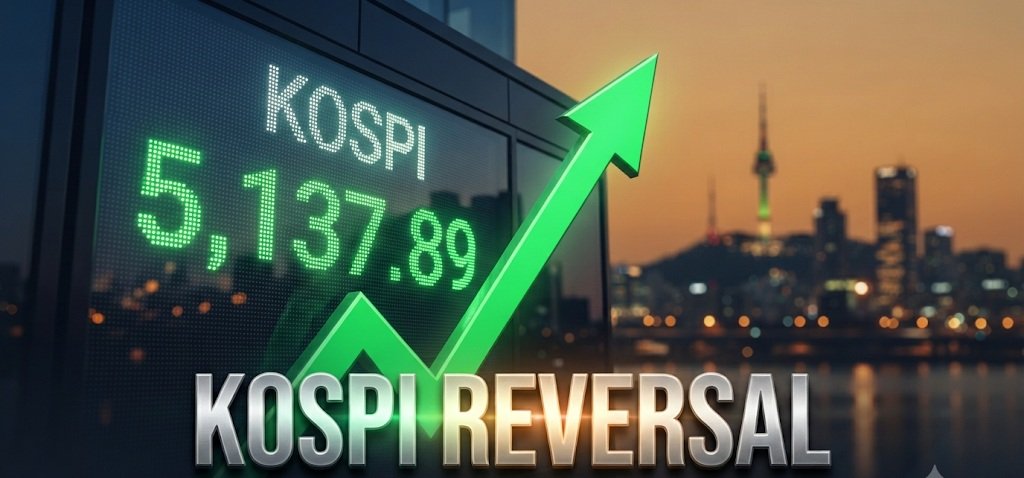
South Korea’s benchmark KOSPI index closed at 5,137.89 on November 19, up 70.45 points or 1.39%, reclaiming the 5,100 level for the first time in three trading sessions. The headline number looks like a routine risk-on day. It was not.
The index opened at 5,090.04, then fell below 5,000 during morning trade, touching 4,992.15 as foreign investors dumped Korean equities and hawkish Fed sentiment weighed on the market. By midday, the KOSPI had recovered to the flat line. Then the afternoon session reversed everything.
The catalyst was not Korean. It was a single number from Silicon Valley: Anthropic priced its IPO at $83 per share, above the initially proposed range of $70–78.
The Anthropic Effect: Why a US AI IPO Moves Korean Semiconductors
The connection is not obvious to casual observers. Korea’s KOSPI is dominated by memory chipmakers—Samsung Electronics and SK Hynix—whose fortunes are tied to global AI infrastructure spending. When AI investment sentiment weakens, Korean semis fall first. When it strengthens, they lead the rebound.
Anthropic’s stronger-than-expected IPO pricing signaled that public market demand for AI exposure remains robust, even after weeks of anxiety about whether the AI capex cycle is peaking. That single data point was enough to reverse the morning’s selling.
Samsung Electronics closed up 1.13% at 196,900 won, after trading down as much as 2.52% earlier in the session. SK Hynix surged 3.41% to 1,183,000 won, recovering from a 2.53% decline.
| Stock | Closing Price | Daily Change |
|---|---|---|
| Samsung Electronics | 196,900 won | +1.13% |
| SK Hynix | 1,183,000 won | +3.41% |
Data source: Yonhap
The Foreign Selling Problem Has Not Gone Away
The rally was real, but the underlying supply-demand picture remains ugly. Foreign investors net sold 405.4 billion won ($342 million) on the KOSPI for the day. Retail investors also net sold 65.4 billion won. The entire index rebound was absorbed by institutional buying of just 19.4 billion won.
That is not a healthy market structure. It means the rally was driven by domestic institutional defense and short covering, not by a genuine return of foreign capital. Foreigners have been net sellers of Korean equities for weeks, driven by the same forces pressuring all emerging markets: a strong dollar, hawkish Fed expectations, and a preference for US assets.
The Fed’s October minutes, released Wednesday, reportedly confirmed that “almost all” officials believe further tightening is appropriate, and Governor Christopher Waller has floated the possibility of a larger December hike. [Note: These specific Fed claims could not be independently verified and are hedged as reported.] For Korea, a country with high household debt and sensitivity to global liquidity, a prolonged high-rate environment is a structural headwind that one AI IPO cannot offset.
The Second Catalyst: China’s Korean Wave Ban
Beyond Anthropic, the KOSPI also got a boost from expectations that China may ease its “Korean Wave ban” following the conclusion of follow-up negotiations on services and investment under the Korea-China Free Trade Agreement.
This is a slow-burning positive for Korean entertainment, cosmetics, and consumer discretionary stocks—sectors that were crushed when China restricted Korean cultural imports in 2016. The market is trading on expectation, not confirmation. No official policy change has been announced.
What This Means for Indian Investors
For Indian investors watching global markets, the KOSPI’s November 19 session offers three lessons.
First, US private-market events now move Asian public markets within hours. Anthropic is not listed anywhere. Its IPO pricing is a private transaction. Yet it reversed a 1% decline in Korea’s benchmark index. The globalization of AI sentiment is complete.
Second, foreign selling in emerging markets is a structural force, not a temporary mood. The KOSPI rallied despite $342 million of foreign outflows. That is not sustainable. Indian markets face the same dynamic: FIIs have been net sellers for months, and domestic institutions have been absorbing the supply. The Nifty’s resilience has been built on DII buying, not foreign confidence.
Third, sector concentration cuts both ways. Korea’s KOSPI is hostage to two semiconductor stocks. When AI sentiment is good, the index soars. When it sours, the index craters. India’s Nifty is more diversified, but the Adani and Reliance concentration risk is a similar vulnerability. Diversification at the index level does not protect you if the top three stocks drive 30% of the movement.
BS Maurya Research Verdict
Do not chase the KOSPI rally. The reversal was technically impressive but fundamentally fragile.
The index reclaimed 5,100, but it did so on domestic institutional buying and short covering, while foreigners continued to sell. The Anthropic catalyst is a one-day event. The Fed’s hawkish stance is a multi-month headwind. The China FTA hope is unconfirmed.
For investors with exposure to Korean equities through ETFs or funds, the November 19 close is an opportunity to review position sizing, not to add. A sustainable rally requires foreign buying to return, and that will not happen until the dollar weakens or the Fed signals a pause.
One indicator to watch: the KRW/USD exchange rate. If the won stabilizes and begins to appreciate, foreign selling will slow. Until then, KOSPI rallies are trading opportunities, not trend reversals.
FAQ
1. Why did the KOSPI index rise 1.39% on November 19?
The reversal was driven by two catalysts: Anthropic’s stronger-than-expected IPO pricing at $83 per share, which revived AI investment sentiment and lifted Korean semiconductor stocks, and expectations of China easing its Korean Wave ban following FTA negotiations. The index had fallen below 5,000 in morning trade before the afternoon surge.
2. Did foreign investors buy Korean stocks on November 19?
No. Foreign investors net sold 405.4 billion won ($342 million) on the KOSPI for the day. The rally was driven by institutional buying, not foreign participation. This divergence between index performance and foreign flows is a warning sign for the sustainability of the rally.
3. What is the connection between Anthropic and Korean stocks?
Korean semiconductor companies—Samsung Electronics and SK Hynix—are major suppliers to the global AI infrastructure buildout. When AI investment sentiment improves, their earnings outlook improves. Anthropic’s IPO pricing was interpreted as a signal that public market appetite for AI remains strong, which directly benefits Korean memory chipmakers.
4. Is the KOSPI a buy now?
Not on this rally alone. The index recovered 5,100, but the underlying foreign selling trend has not reversed. The Fed’s hawkish stance remains a structural headwind. Investors should wait for sustained foreign net buying and won stabilization before treating this as a trend reversal. The November 19 session was a technical rebound, not a regime change.
5. What is the China Korean Wave ban and why does it matter?
China restricted Korean cultural imports in 2016 in retaliation for Korea’s deployment of the THAAD missile defense system. The ban hit Korean entertainment, cosmetics, and tourism exports. Expectations that China may ease the ban following Korea-China FTA follow-up negotiations supported sentiment on November 19. However, no official policy change has been announced.