The Indian stock market has delivered its strongest weekly performance since February 2021, giving investors an extraordinary rally just ahead of Diwali and Muhurat Trading.
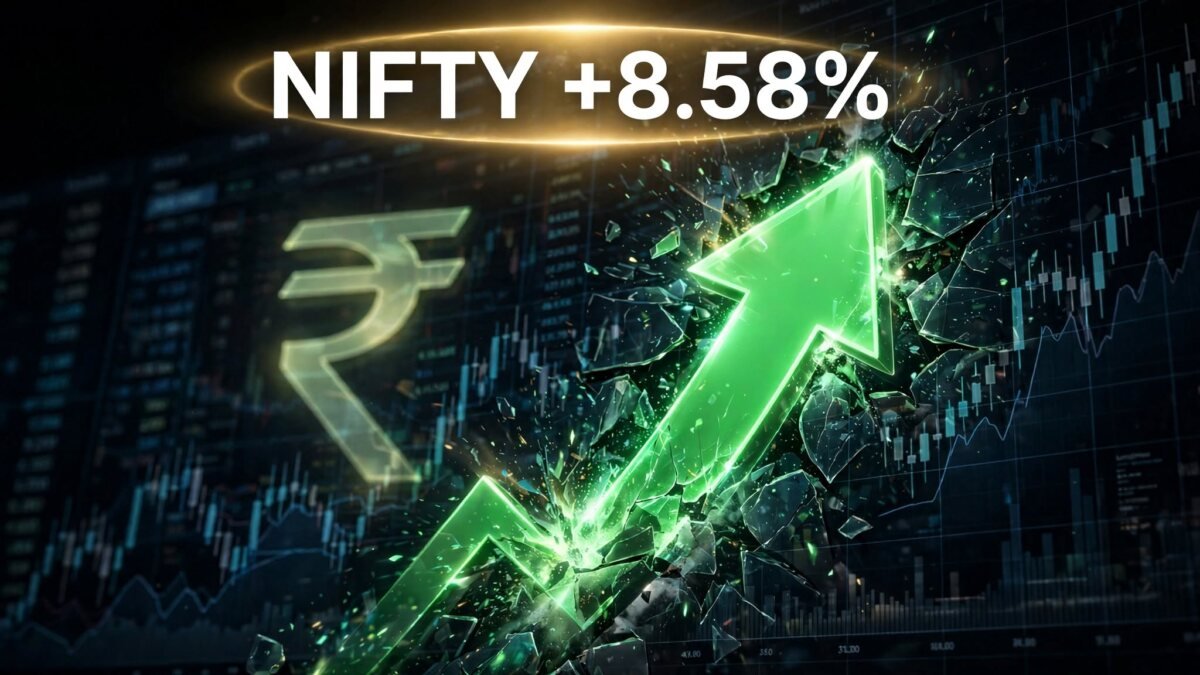
During the week ended November 6, 2026, the Nifty 50 surged 8.58%, gaining 1,977.25 points to close at 25,030.35. The BSE Sensex climbed 8.82%, adding 6,568.49 points to settle at 81,028.02.
Both benchmark indices recorded their biggest weekly percentage gains since February 2021. The rally also extended their winning streak to seven consecutive trading sessions.
The surge added approximately ₹28.70 lakh crore to the market capitalisation of BSE-listed companies. Their combined market value increased from around ₹474.37 lakh crore to ₹503.07 lakh crore.
But what triggered such a powerful rally, and can the momentum continue into Samvat 2083?
The Three Major Triggers Behind the Rally
1. Global AI Sell-Off and the US Midterm Election Effect
One of the major global developments behind the rally was the sharp sell-off in US technology and AI-linked stocks.
The US midterm elections on November 3 resulted in sweeping Democratic gains. Investors became concerned that the political shift could bring tighter scrutiny of AI infrastructure, data centres and related investments.
The Nasdaq Composite fell sharply, while the Nasdaq 100 and semiconductor stocks also suffered heavy losses. The sell-off wiped out approximately $2.5 trillion in market value from the Nasdaq market.
India’s relatively limited exposure to the capital-intensive AI infrastructure trade helped its equity market appear comparatively attractive during this period.
However, it would be inaccurate to say that all the foreign money entering India came directly from investors exiting AI stocks. The global sell-off was one factor among several supporting the change in sentiment towards Indian equities.
2. Foreign Investors Returned with Heavy Buying
Foreign institutional investors (FIIs) were among the strongest drivers of the Indian market’s recovery.
Based on provisional cash-market flow figures for November 2–6, foreign investors bought approximately ₹45,960 crore worth of Indian equities during the five trading sessions.
The biggest single-day purchase came on November 5, when FIIs bought approximately ₹14,975 crore. It was their largest single-day net purchase in nearly six years.
Domestic institutional investors (DIIs), meanwhile, were net sellers of approximately ₹24,197 crore during the same five-session period.
This strong foreign buying helped absorb substantial domestic institutional selling and supported the sharp rise in benchmark indices.
The important question now is whether foreign investors will continue buying after such a rapid market recovery. A few strong sessions do not necessarily confirm a long-term reversal in foreign investment flows.
3. Crude Oil Prices Fell and the Rupee Strengthened
The fall in crude oil prices provided another important boost to Indian equities.
Brent crude was on track for a weekly decline of approximately 17%, settling around $98.32 per barrel on November 6. This was its steepest weekly fall since the early stages of the COVID-19 pandemic.
Expectations of reduced geopolitical risk after the US midterm elections contributed to the decline. However, concerns about weaker demand and additional global supply also weighed on prices.
For India, which depends heavily on imported crude oil, lower oil prices can reduce pressure on the import bill, inflation and operating costs for several industries.
The Indian rupee also strengthened during the week, closing at approximately ₹93.91 against the US dollar.
A stronger rupee combined with cheaper crude can improve India’s external balance and provide some relief to businesses that depend on imported energy and raw materials. However, the benefits depend on how long these conditions last.
Corporate Earnings Provided Additional Support
The rally was not driven by global developments and foreign buying alone. Corporate earnings also helped improve investor sentiment.
Reliance Industries reported its highest-ever quarterly profit for Q2 FY27. Its consolidated profit after tax, including the share of profit from associates and joint ventures, reached ₹29,550 crore, up approximately 33.8% year-on-year.
The company’s oil-to-chemicals business also reported a strong performance, providing support to its overall results.
Other major companies, including Mahindra & Mahindra and Bharti Airtel, also reported their September-quarter results during the earnings season.
Strong results from large companies helped reinforce confidence in parts of the Indian corporate earnings story. However, individual company results should not be treated as proof that every sector or every Nifty constituent is experiencing the same level of earnings growth.
Was the Rally Broad-Based?
Although the headline indices recorded exceptional gains, investors should look beyond the Nifty and Sensex.
The broader market also participated during the week. The Nifty Midcap 100 gained approximately 5.8%, while the Nifty Smallcap 100 advanced around 2.8%.
However, the final trading session on November 6 showed some weakness in parts of the broader market. The Nifty Midcap 150 and Nifty Smallcap 250 ended that session slightly lower.
The India VIX, a measure of expected market volatility, also rose by approximately 14% during the week, ending around 17.55.
A rising VIX does not automatically mean that the market will fall. It indicates that investors are pricing in greater expected volatility, making it an important risk indicator after a sharp rally.
What Should Investors Watch Before Muhurat Trading?
The market has delivered an impressive recovery, but investors should avoid assuming that prices will continue rising at the same speed.
Here are three important factors to watch:
1. Whether FII buying continues
Foreign investors have returned with substantial buying. If these inflows continue, they could provide further support to large-cap stocks. But a reversal in global sentiment could quickly change the direction of these flows.
2. Crude oil and the rupee
Lower crude prices and a stronger rupee are positive developments for India’s macroeconomic outlook. Any renewed geopolitical tensions or sharp reversal in oil prices could put pressure on the market.
3. Market volatility and valuations
The rise in India VIX suggests that uncertainty has not disappeared. After an 8.58% weekly jump in the Nifty, investors should also consider the possibility of profit-booking and short-term corrections.
What Long-Term Investors Should Consider
Long-term investors should focus on company fundamentals, earnings quality, valuations and their own investment time horizon rather than reacting to a single strong week.
A sharp rally does not automatically make every stock attractive. Investors should avoid chasing stocks only because they have risen rapidly.
What Short-Term Traders Should Watch
Short-term traders should monitor market breadth, volatility, foreign institutional flows and important support and resistance levels.
After such a strong advance, sudden price swings and profit-booking are possible. Risk management remains important, particularly when volatility is rising.
The Big Question for Samvat 2083
The Indian stock market enters the new Samvat year with strong momentum.
Foreign investors have returned, crude oil prices have fallen sharply, the rupee has strengthened and major companies have reported encouraging results.
But the rally has also happened against a backdrop of global uncertainty and rising volatility.
The sustainability of the move will depend on whether foreign buying continues, corporate earnings remain resilient and global risks stay under control.
For investors, the lesson is simple: celebrate the rally, but do not confuse a strong week with a guarantee of future returns.
FAQ
Q1: Why did the Indian stock market rally so sharply during the week ended November 6, 2026?
The rally was supported by heavy foreign institutional buying, falling crude oil prices, a stronger rupee, encouraging corporate earnings and improved relative sentiment towards Indian equities during a global technology and AI-stock sell-off.
Q2: How much did the Nifty and Sensex gain?
The Nifty 50 gained 8.58%, or 1,977.25 points, to close at 25,030.35. The Sensex advanced 8.82%, or 6,568.49 points, to settle at 81,028.02. Both recorded their strongest weekly percentage gains since February 2021.
Q3: How much did FIIs and DIIs buy or sell?
Based on provisional cash-market figures for November 2–6, FIIs were net buyers of approximately ₹45,960 crore, while DIIs were net sellers of approximately ₹24,197 crore.
Q4: How much wealth did the stock market rally add?
The market capitalisation of BSE-listed companies increased by approximately ₹28.70 lakh crore during the week, rising from around ₹474.37 lakh crore to ₹503.07 lakh crore.
Q5: Did midcap and smallcap stocks also participate in the rally?
Yes. The Nifty Midcap 100 gained approximately 5.8%, and the Nifty Smallcap 100 rose around 2.8% during the week. However, some broader-market indices declined slightly in the final trading session.
Q6: Is the stock market rally sustainable?
The outlook depends on continued FII buying, corporate earnings, crude oil prices, currency movements and global risk sentiment. The sharp rise in India VIX also suggests that volatility remains a risk.
Q7: What should investors watch in Samvat 2083?
Investors should monitor foreign fund flows, crude oil prices, the rupee, corporate earnings, market valuations and volatility. A disciplined investment approach is more useful than chasing stocks after a sharp rally.
Disclaimer: This article is for informational and educational purposes only. It is not investment advice or a recommendation to buy or sell any security.