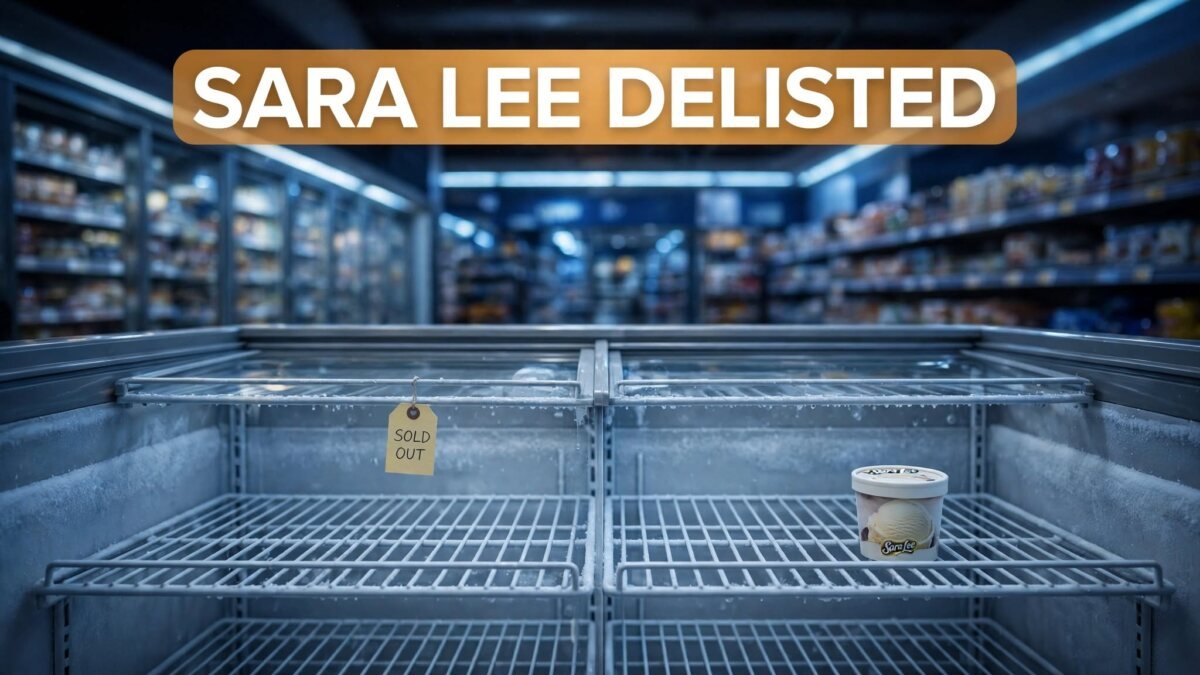
If you have walked down the frozen aisle at Coles recently looking for a tub of Sara Lee ice cream, you have probably noticed an empty space.
The iconic Australian brand’s one-litre ice cream tubs have been quietly removed from Coles shelves. The delisting happened last month following what Coles described as a “routine review of its ice cream range, taking into account customer preferences and shopping habits” .
Woolworths, Australia’s other supermarket giant, stopped stocking the same range roughly two years ago . That means neither of the country’s two biggest supermarket chains now carries Sara Lee’s five-flavour ice cream tubs.
For shoppers, it is an inconvenience. For anyone studying retail strategy, it is a textbook example of how private-label brands have reshaped the balance of power between supermarkets and the brands they stock.
Where Sara Lee Ice Cream Went
Sara Lee has confirmed the delisting and clarified that the product has not disappeared entirely. In a social media statement, the brand said its ice cream is “now exclusively available at selected independent retailers” .
Shoppers can still find the one-litre tubs at IGA and independent grocers. Sara Lee’s other frozen desserts—pies, cheesecakes, and other products—remain available at major supermarkets .
The key distinction: it is the ice cream tubs specifically that have been delisted, not the entire Sara Lee range.
Why Coles and Woolworths Are Dropping Iconic Brands
The answer lies in the freezer aisle itself. Over the past several years, both Coles and Woolworths have aggressively expanded their own private-label ice cream ranges. These store-brand products offer comparable flavours at noticeably lower price points, and they now occupy prime freezer real estate that was once reserved for branded products .
This is not a new strategy. Supermarkets globally have been building private-label portfolios for decades. But the pace has accelerated. In an inflationary environment, shoppers are more price-sensitive. A $4 store-brand vanilla ice cream competes directly with a $7 branded equivalent. For many families, the difference is not worth paying.
Coles and Woolworths have also invested heavily in improving the quality of their own brands. The days when private label meant “cheap and inferior” are largely gone. In blind taste tests, store-brand ice creams often perform surprisingly well against established names.
For Sara Lee, the delisting means losing access to the two largest distribution channels in Australia. Independent retailers and IGA stores provide an alternative, but they represent a fraction of the supermarket traffic that Coles and Woolworths command.
The Broader Retail Trend: Brands Under Pressure
Sara Lee is not alone. Across categories—from pasta sauces to cleaning products—supermarkets are using their shelf space to promote their own brands, which carry higher margins. For the supermarket, a private-label sale is more profitable than a branded sale. For the brand, losing shelf space at Coles or Woolworths can be existential.
The dynamic is particularly acute in Australia, where Coles and Woolworths together control roughly 65% of the grocery market. Brands that lose access to both retailers face a dramatic reduction in reach.
Some brands fight back with innovation—new flavours, premium packaging, or health-focused formulations that store brands cannot easily replicate. Others accept the shift and pivot toward independent channels, food service, or export markets.
Sara Lee’s path appears to be the latter. The brand is not withdrawing from the market. It is retreating to channels where it can still find customers.
What This Means for Shoppers
For consumers, the trade-off is straightforward. Fewer branded options mean more private-label choices. Lower prices are a genuine benefit, particularly for families watching grocery budgets. But the loss of iconic brands reduces variety and, for loyal customers, removes a product they have bought for years.
The good news for Sara Lee fans: the ice cream is still available at IGA and independent grocers. The detour is inconvenient, but the product has not vanished.
The Bottom Line
Sara Lee’s delisting from Coles and Woolworths is not a story about a brand failing. It is a story about retail power. When two supermarkets control two-thirds of the grocery market, their shelf decisions determine which brands thrive and which struggle. Private labels are winning freezer space because they offer better margins and competitive quality. Sara Lee is adapting by focusing on channels where it still has a presence.
For business students and retail analysts, this is a case study worth watching. For ice cream lovers in Australia, it is a reminder to check the independent grocer before giving up.
FAQ
Q1: Can I still buy Sara Lee ice cream in Australia?
Yes. Sara Lee’s one-litre ice cream tubs are now exclusively available at selected independent retailers, including IGA and independent grocers. They are no longer stocked at Coles or Woolworths .
Q2: Why did Coles remove Sara Lee ice cream?
Coles said the decision followed a “routine review of its ice cream range, taking into account customer preferences and shopping habits.” The broader reason is the expansion of supermarket private-label ice cream brands, which offer lower prices and higher margins .
Q3: Is Sara Lee going out of business?
No. Sara Lee’s other frozen desserts remain available at major supermarkets. Only the one-litre ice cream tub range has been delisted from Coles and Woolworths .
Q4: When did Woolworths stop stocking Sara Lee ice cream?
Woolworths phased out the Sara Lee ice cream tubs roughly two years ago, before Coles made its decision in 2026 .
Q5: What is a private label and why does it matter?
A private label (or store brand) is a product manufactured for and sold under a retailer’s own name. Supermarkets prefer private labels because they carry higher margins than branded products. As private-label quality has improved, more shoppers are choosing them over established brands.