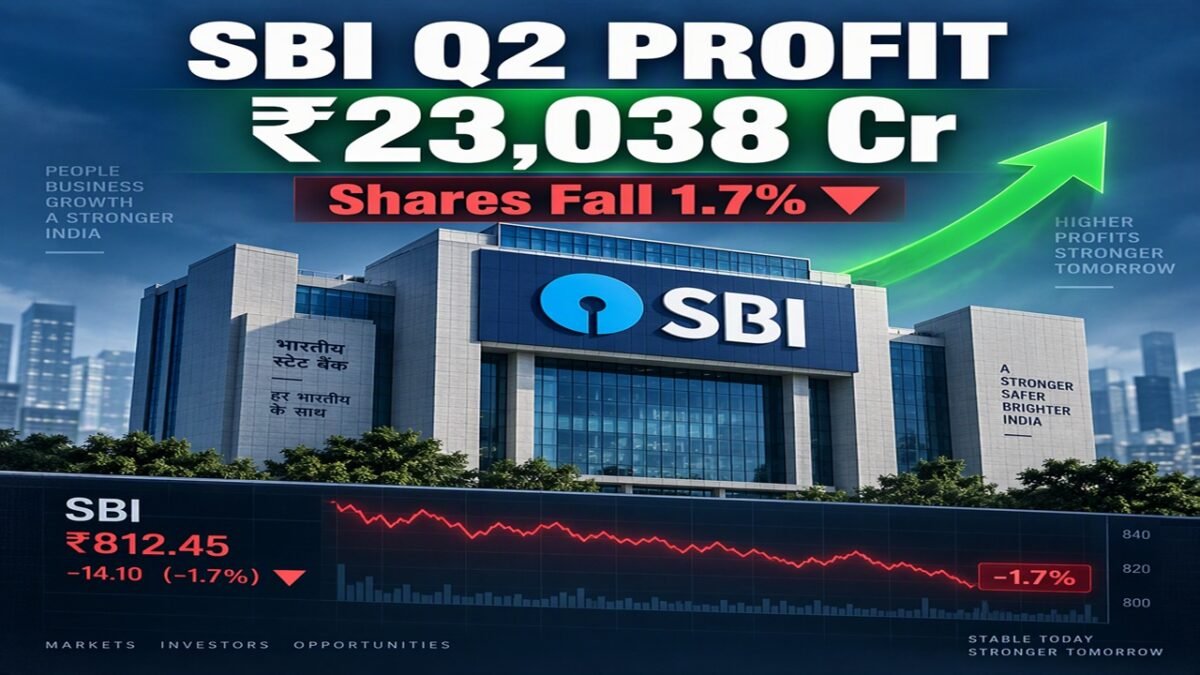
State Bank of India delivered a quarter that looked good on the surface. The market, however, saw something else.
India’s largest lender reported a 14.3% year-on-year rise in standalone net profit to ₹23,038 crore for Q2 FY27, beating the CNBC-TV18 poll estimate of ₹22,859 crore. Net interest income (NII) rose 14.7% to ₹49,143 crore, also ahead of the ₹47,901 crore estimate .
Asset quality improved sharply. Gross NPA fell to 1.39%, down from 1.47% in the previous quarter and 1.73% a year ago. The bank said this is its lowest gross NPA ratio in more than two decades. Net NPA stood at 0.36% .
Yet SBI shares closed 1.7% lower at ₹970.25 on Tuesday. The stock had touched an intraday high of ₹1,006.55 before giving up all gains .
Why the Market Was Not Impressed
The profit beat was not entirely organic. SBI booked an exceptional gain of ₹7,289 crore during the quarter, primarily from the sale of a stake in SBI Funds Management. In the year-ago quarter, the exceptional gain was ₹4,593 crore. The higher one-time gain inflated the profit growth number .
Operating profit actually declined. SBI’s operating profit fell 1.4% year-on-year to ₹26,937 crore from ₹27,311 crore. This is the number that reflects the bank’s core day-to-day earnings before provisions and taxes. A decline here tells you the underlying business momentum is not as strong as the headline profit suggests .
Other income fell sharply. Non-interest income declined 23.8% to ₹11,777 crore, dragged down by lower treasury income and fee-based earnings .
The Strong Parts You Should Not Ignore
Loan growth was solid. SBI’s gross advances grew 17.84% year-on-year to ₹52.08 lakh crore. Retail personal loans rose 14.54%, SME advances jumped 21.97%, and agricultural loans grew 22.64%. Corporate advances increased 16.12% .
Margins improved sequentially. Domestic net interest margin (NIM) expanded by 11 basis points to 3.11% from the previous quarter, though it was marginally lower than 3.08% a year ago on a whole-bank basis .
Provisioning fell. Provisions for bad loans dropped 21.9% to ₹4,217 crore, which directly boosted the bottom line. Credit cost declined to 0.22% .
What This Means for Investors
SBI remains one of the strongest franchises in Indian banking. Its asset quality is the best it has been in decades, loan growth is healthy, and it trades at valuations that are undemanding compared to private sector peers.
But this quarter’s headline numbers flatter the underlying performance. The profit beat came from a one-time gain and lower provisions, not from stronger core operations. Operating profit declining is a signal worth watching.
For long-term investors, SBI is still a reasonable holding. The bank maintained its credit growth guidance of 14–15% and expects to keep NIM above 3% for FY27 . The asset quality story is genuinely strong.
For short-term traders, the stock’s reaction tells you the market was looking for more. A 1.7% decline on a day when the Nifty was holding up is a sign of disappointment. The stock may remain range-bound until the next quarter shows operating profit growth returning.
FAQ
Q1: What was SBI’s Q2 FY27 net profit?
SBI reported a standalone net profit of ₹23,038 crore, up 14.3% year-on-year, beating the estimate of ₹22,859 crore .
Q2: Why did SBI shares fall despite good results?
Operating profit declined 1.4% year-on-year, and the profit beat was aided by a one-time gain of ₹7,289 crore from the SBI Funds Management stake sale. Other income also fell 23.8% .
Q3: What is SBI’s gross NPA now?
Gross NPA improved to 1.39%, the lowest in more than two decades. Net NPA stood at 0.36% .
Q4: Is SBI a good buy after Q2 results?
SBI remains fundamentally strong with improving asset quality and healthy loan growth. However, the decline in operating profit is a concern. Long-term investors can hold, but near-term upside may be limited until core earnings growth returns.