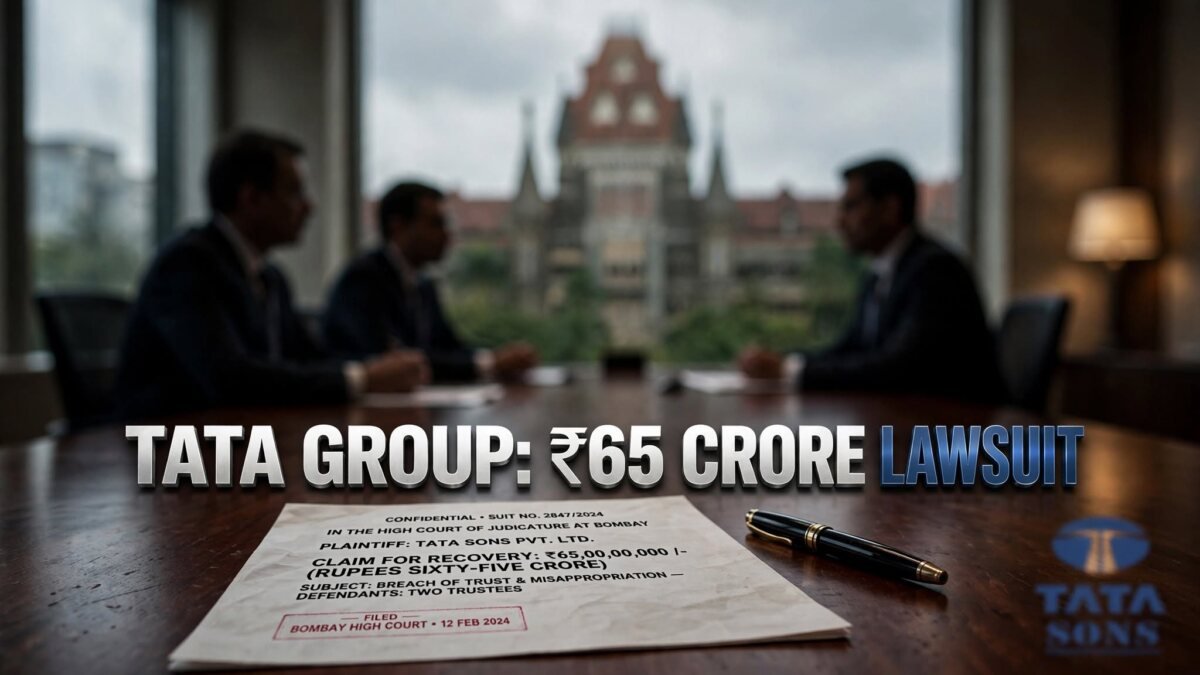
Tata Group stocks are under scrutiny Friday as the Sir Dorabji Tata Trust and the R.D. Tata Trust pursue legal action against Tata Sons and six of its directors, challenging N. Chandrasekaran’s reappointment as executive chairman and seeking collective damages of ₹65 crore. The Bombay High Court is scheduled to hear the matter today, with Justice Abhay Ahuja presiding after Justice Arif Doctor recused himself from the case.
What the Lawsuit Actually Alleges
The two trusts filed circular resolutions dated November 25, 2026, seeking trustee approval to initiate proceedings. Their core argument is procedural: the Tata Sons board’s September 17 decision to reappoint Chandrasekaran for a second five-year term was invalid because it did not secure the affirmative vote required under Article 121 of the company’s Articles of Association.
Article 121 governs how Tata Sons must conduct critical board decisions. The trusts contend that the reappointment vote fell short of the required threshold, rendering the decision legally defective. The ₹65 crore damages claim represents the collective financial harm the trusts allege they have suffered as a result.
This is not a routine governance dispute. The Tata Trusts collectively own roughly 66% of Tata Sons, the holding company that controls the sprawling Tata empire. When the trusts sue the holding company’s board, the conflict cuts to the heart of how India’s most iconic business group is governed.
Why This Matters for Retail Investors in Tata Group Stocks
Retail investors holding Tata Motors, Tata Steel, TCS, Tata Power, or any of the group’s listed entities are not direct parties to this dispute. But the outcome carries indirect consequences that are difficult to ignore.
First, leadership uncertainty at the top creates a valuation overhang. Chandrasekaran has overseen a significant restructuring of the Tata group since taking over in 2017, including the consolidation of Tata Steel’s European operations, the Tata Motors-JLR turnaround, and the group’s push into digital and EV businesses. If his reappointment is legally challenged or reversed, the strategic continuity that investors have priced in becomes uncertain.
Second, the dispute exposes governance friction between the trusts and Tata Sons. The trusts are not activist shareholders seeking a quick exit. They are the ultimate custodians of Tata’s philanthropic legacy. A public legal battle between them and the operating holding company signals a breakdown in internal consensus that could affect decision-making across the group.
Third, the timing is awkward. The hearing comes as Tata Group stocks have been active in the market. Tata Motors recently increased its stake in Automobile Corporation of Goa to 50.17%, making ACGL a subsidiary. Tata Steel is still digesting its complex APL Apollo transaction. Any negative headline risk from the courtroom adds a layer of uncertainty to stocks that already face sector-specific pressures.
The Broader Tata Group Moves This Week
The lawsuit is not the only development affecting Tata Group stocks. On the corporate front, Tata Motors completed its buyback-driven stake increase in ACGL, a move that consolidates its position in the Goa-based commercial vehicle body maker. The transaction is small in financial terms but signals Tata Motors’ willingness to tighten control over its supply chain subsidiaries.
Separately, the NSE received RBI approval to introduce futures contracts on corporate bond indices, a development that expands the exchange’s derivatives footprint and indirectly benefits the broader market infrastructure ecosystem in which Tata Group companies participate.
None of these operational developments offset the governance question. The market can absorb a ₹65 crore damages claim. It is less comfortable with a public split between the trusts and the chairman they appointed.
What to Watch at Today’s Hearing
The Bombay High Court hearing will focus on procedural questions: whether the trusts have standing to challenge the reappointment, whether the Article 121 violation claim is substantiated, and whether interim relief is warranted. Justice Ahuja’s decision on whether to admit the petition will set the tone for the next phase of the dispute.
If the court admits the petition and grants interim relief—for example, staying the reappointment pending a full hearing—the governance uncertainty intensifies. If the court dismisses the petition or defers it without interim relief, Chandrasekaran’s position remains secure in the near term, and the market can return its focus to earnings and operational performance.
The trusts have already sought their trustees’ approval through circular resolutions, suggesting they have prepared for a sustained legal campaign rather than a one-day headline. This is a dispute that will take months, not days, to resolve.
BS Maurya Research Verdict
Tata Group stocks should not be sold on this headline alone. The lawsuit is serious, but it is a governance dispute at the holding company level, not an operational crisis at any listed entity. Tata Motors, Tata Steel, and TCS derive their valuations from their own businesses, not from the internal politics of Tata Sons.
That said, retail investors should watch for escalation signals. If additional trusts join the petition, if the court grants interim relief staying the reappointment, or if Chandrasekaran’s position becomes untenable, the governance overhang expands. In that scenario, the group’s listed entities could face a valuation discount that reflects leadership uncertainty rather than business fundamentals.
For now, the appropriate stance is watchful patience. The hearing today will provide the first signal of how the court views the trusts’ case. Until then, Tata Group stocks remain what they were before this lawsuit: a collection of businesses with varying fundamentals, some attractive, some challenged, none defined primarily by the chairman’s legal status.
Frequently Asked Questions
1. Why are Tata Group stocks in focus today?
Two Tata Trusts have sued Tata Sons and six directors, challenging N. Chandrasekaran’s reappointment as executive chairman and seeking ₹65 crore in damages. The Bombay High Court hears the matter on November 27.
2. Which trusts are involved in the lawsuit?
The Sir Dorabji Tata Trust (SDTT) and the R.D. Tata Trust (RDTT) filed the petition. They allege that the September 17 reappointment decision violated Article 121 of Tata Sons’ Articles of Association.
3. Does this lawsuit affect Tata Motors, TCS, or Tata Steel shares?
Not directly. The lawsuit targets Tata Sons, the unlisted holding company. Listed Tata Group entities are affected only indirectly, through potential leadership uncertainty and governance sentiment.
4. What happens if the court rules against Chandrasekaran’s reappointment?
Tata Sons would need to reconstitute its leadership, potentially triggering a new succession process. The strategic direction Chandrasekaran has set could be reviewed, creating uncertainty for investors across the group.
5. Should retail investors sell Tata Group stocks now?
No single governance headline justifies selling. Investors should monitor the court proceedings for escalation signals—additional trusts joining, interim relief granted, or Chandrasekaran’s position becoming untenable—before adjusting their positions.