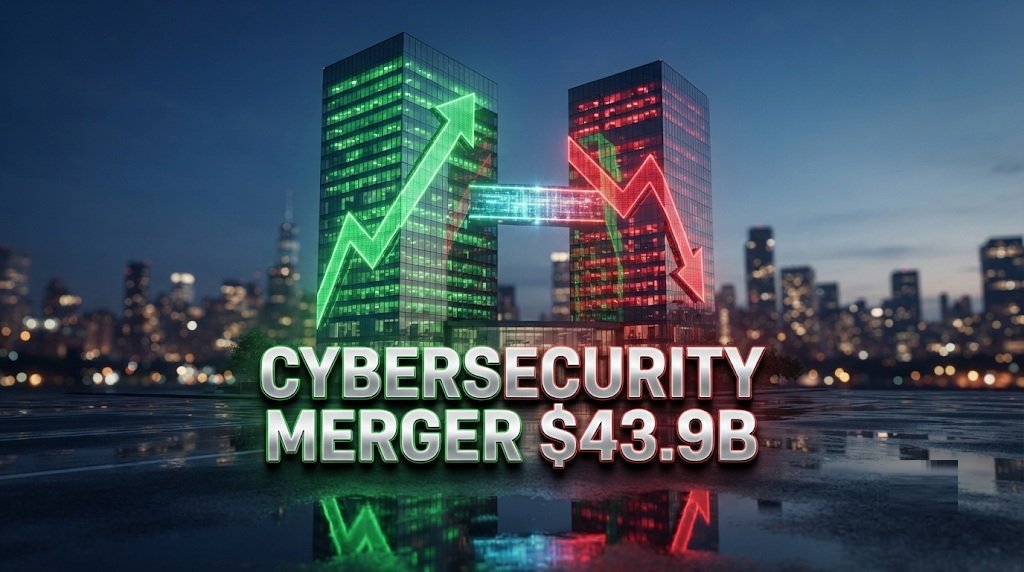
The CrowdStrike Zscaler acquisition just rewrote the cybersecurity playbook. CrowdStrike (CRWD) announced a $43.9 billion all-stock deal to acquire Zscaler (ZS) — the largest cybersecurity merger in history — and the market’s verdict was instant and brutal. CRWD collapsed -10.84% to $204.56 while ZS rocketed +15.01% to $224.09 on 12.6 million shares, more than 4x its 3-month average volume. This is a textbook merger-arbitrage split, and retail investors need to understand exactly why the two stocks moved in opposite directions before touching either ticker.
Why the CrowdStrike Zscaler Acquisition Split the Two Stocks
An all-stock acquisition creates a simple mechanical truth: the acquirer pays in its own currency, and the market reprices that currency for dilution. CrowdStrike is issuing shares to fund the $43.9B price tag, which dilutes existing CRWD holders. Meanwhile, Zscaler shareholders receive CRWD stock at a premium — so ZS trades up to reflect the deal value.
The numbers make the dynamic crystal clear:
| Metric | CRWD (Acquirer) | ZS (Target) |
|---|---|---|
| Price | $204.56 | $224.09 |
| 1-Day Change | -10.84% | +15.01% |
| Volume | 23.6M | 12.6M |
| Avg Vol (3M) | 10.2M | 3.0M |
| P/E Ratio (TTM) | 3,401.00 | N/A (unprofitable) |
| Market Cap | $208.9B | $36.4B |
| 52-Week Change | +81.08% | -30.51% |
The +81.08% 52-week run in CRWD is precisely why the stock fell. When a high-multiple acquirer uses stock as currency after a massive run, the dilution math is painful. CrowdStrike’s 3,401x trailing P/E means every dollar of stock issued is priced at an extreme multiple — and the market immediately marked that down.
CRWD Stock Analysis: The Dilution Math Retail Investors Miss
Here is the part most headlines skip. CrowdStrike is paying $43.9 billion for a company with a $36.4 billion market cap. That is a meaningful premium, and it is being funded entirely in CRWD shares. Two consequences follow:
-
Share count expansion: The deal will materially increase CRWD’s outstanding shares, spreading earnings across a larger base. For a company already trading at 3,401x trailing earnings, even modest EPS dilution looks severe on paper.
-
Integration risk premium: Zscaler is a zero-trust network access specialist. CrowdStrike is an endpoint protection leader. The strategic logic — a unified cloud security platform — is sound, but merging two high-growth, high-burn companies is operationally messy.
The market is not questioning whether the deal is strategic. It is questioning whether CRWD shareholders are overpaying in a currency that just ran 81% in a year. That is a valuation event, not a thesis break.
For primary-source detail on merger terms and regulatory filings, the SEC’s EDGAR database will carry the definitive 8-K and S-4 disclosures as the deal progresses.
Why ZS Stock Soared 15% and What Comes Next
Zscaler holders woke up to a windfall. ZS jumped +15.01% because the acquisition price represents a premium to where ZS was trading, paid in the stock of a larger, stronger platform. Volume at 12.6 million versus a 3-month average of 3.0 million confirms institutional arbitrageurs piling in.
But there is a catch for anyone buying ZS today: the stock now trades as a merger-arbitrage instrument, not as an independent growth company. Its price will track CRWD shares (since the consideration is CRWD stock) plus a deal-completion spread. If CRWD keeps falling, ZS will follow — the +15% pop is already fading into a pegged relationship.
For retail investors, the cleaner exposure is arguably the acquirer once dilution fears settle, not the target at a deal premium. Our Market Trends coverage tracks how large-cap tech mergers historically resolve for both sides.
The Bigger Picture: Cybersecurity Consolidation Is Accelerating
This deal is not happening in a vacuum. It landed on the same session that Nvidia surged +32.59% and Dell jumped +22.48% — a broad risk-on rotation across AI and enterprise tech. Cybersecurity is consolidating because enterprises want fewer vendors, not more. CrowdStrike buying Zscaler is a direct bet that the winner in security will be the platform, not the point solution.
Three implications for retail portfolios:
-
Platform premiums: Companies with unified security stacks will command premium multiples; single-product vendors face acquisition or irrelevance.
-
Dilution is the new risk factor: In an all-stock deal era, acquirer shareholders bear the currency risk. Watch share count, not just revenue synergies.
-
Regulatory scrutiny: A $43.9B deal will draw antitrust review. Timeline risk is real and can cap the arbitrage spread.
If you hold cybersecurity exposure through ETFs or mutual funds, our Mutual Funds & SIP guide explains how merger events flow through fund NAVs.
BS Maurya Research Verdict
The CrowdStrike Zscaler acquisition is strategically sound and financially expensive for CRWD holders. The -10.84% drop is a rational dilution repricing, not a panic signal — and it may create an entry window for long-term investors who believe in the unified-platform thesis. ZS at +15.01% is now a merger-arbitrage vehicle; buying it for growth exposure no longer makes sense at the deal premium. Retail investors should watch the S-4 filing for exact exchange ratios, avoid chasing ZS at the pop, and consider CRWD only on further dilution-driven weakness with a multi-year horizon. Do not confuse a strategic deal with a short-term trade.
FAQ
-
Why did CrowdStrike stock fall 11% on the Zscaler deal?
CrowdStrike is funding the $43.9B acquisition with its own stock, which dilutes existing shareholders. After an +81% 52-week run and at a 3,401x trailing P/E, the market immediately repriced CRWD for the share issuance. -
Why did Zscaler stock jump 15%?
Zscaler shareholders are receiving CRWD stock at a premium to ZS’s prior price. Arbitrageurs piled in — volume hit 12.6 million versus a 3.0 million 3-month average — pushing ZS up to reflect the deal value. -
Is the CrowdStrike Zscaler deal good for long-term investors?
The strategic logic of a unified cloud security platform is sound, but integration risk and dilution are real. Long-term CRWD holders should watch the S-4 filing for exact exchange ratios and treat near-term weakness as a potential entry window, not a thesis break. -
Should I buy Zscaler stock now?
ZS is now a merger-arbitrage instrument pegged to CRWD’s share price plus a deal-completion spread. Buying it for independent growth exposure no longer makes sense at the premium — the clean growth thesis has been replaced by deal mechanics. -
Will regulators block the CrowdStrike Zscaler merger?
A $43.9B deal will draw antitrust review, and timeline risk is real. Regulatory scrutiny can widen or narrow the arbitrage spread, so monitor filings with the SEC and FTC for deal-progress updates.