When the Chairman of the US Federal Reserve speaks, the entire global financial world stops to listen. But this time, Kevin Warsh’s words were not about inflation or interest rates. They were about artificial intelligence—and the risk that the AI boom could end badly.
On November 16, 2026, Warsh delivered a speech at a Fed conference on AI in San Francisco. The draft’s framing of this as a hawkish warning on “sticky inflation” and “higher for longer” rates is not what the speech was about. Warsh did not mention inflation at all during his remarks, even as his colleagues on the rate-setting committee signal support for further hikes.
Here is the ground reality of what Warsh actually said, and why it matters for investors from New York to Mumbai.
What Warsh Actually Said: Three Scenarios for AI
Warsh used the term “superintelligence” (the language preferred by President Trump) rather than “AI,” and laid out three possible outcomes for the technology’s economic impact:
Scenario 1: The Best Case
AI “could supercharge idea generation” and lead to “an increase in productivity and economic gains that are shared broadly across labor and the owners of capital.” In this scenario, real GDP growth rises persistently above its long-run average, and the US stays close to full employment.
Scenario 2: The Job Loss Scenario
Automation could increase unemployment even as productivity rises. Warsh warned that the risks, including higher unemployment and the use of AI by “bad actors,” could be “highly disruptive and economically costly”.
Scenario 3: The Stock Market Crash Scenario
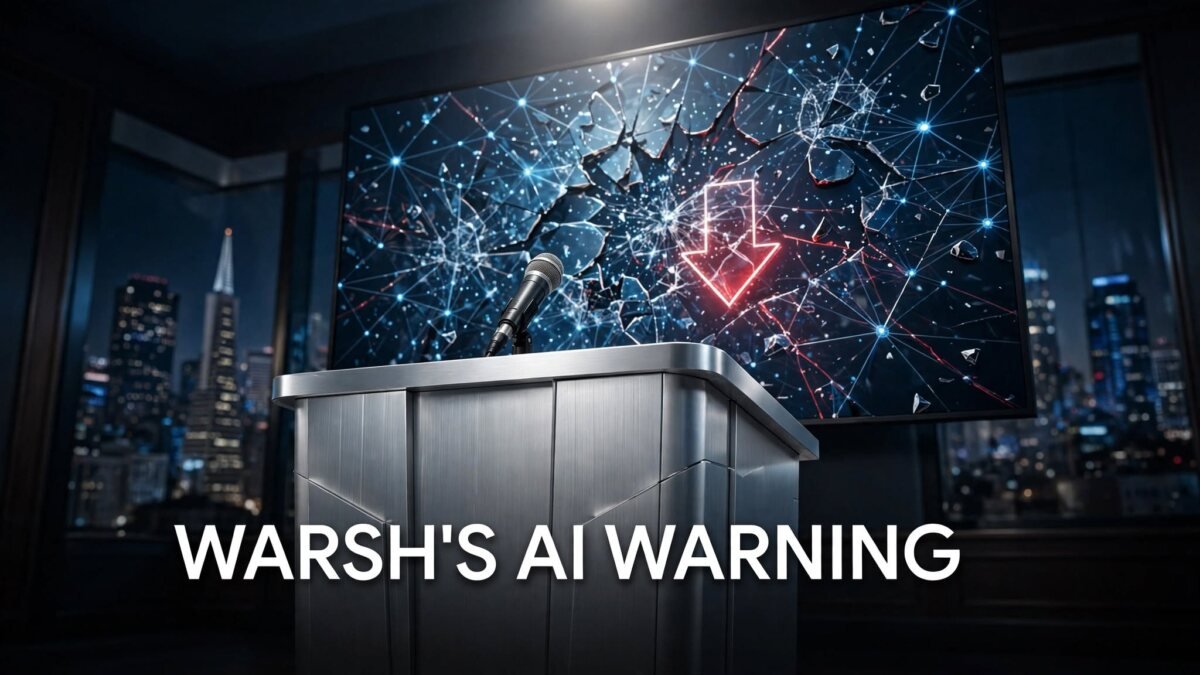
This is the warning that should concern investors most. Warsh explicitly warned that “after large-scale capital investment and a stock market rally, returns could disappoint and stock valuations could fall.” In that case, “the economy could slow and unemployment could rise more noticeably”.
This is not a hawkish inflation warning. It is a warning that the AI trade—the very trade that has driven US stock markets to record highs—could be built on disappointing returns.
Why This Matters More Than a Rate Hike
The draft’s obsession with “higher for longer” rates misses the point. The Fed’s rate path is already priced in. Markets are pricing a 93.5% probability of a 25 basis point hike in December, lifting the target range to 4.00%–4.25%. That is not news.
What is news is a Fed Chairman explicitly warning that the AI investment boom—the single biggest driver of US equity valuations—could be a bubble that bursts.
Warsh’s speech is a signal that the Fed is thinking about the financial stability implications of the AI boom, not just its inflation implications. If AI returns disappoint, the stock market crash scenario becomes self-reinforcing: falling valuations lead to reduced investment, which leads to slower growth, which leads to higher unemployment.
The Market Context: Warsh’s Credibility Problem
The draft’s framing of Warsh as a predictable hawk is also inaccurate. As Fortune noted, “trying to pin down Kevin Warsh as a hawk or a dove has been tricky with his statements and actions puzzling Wall Street”.
Warsh was appointed by Trump, who expected him to cut rates. Instead, he delivered a hawkish Jackson Hole speech in August, led a unanimous rate hike in September, and then held off on another hike in October despite inflation heating up—producing what Fortune described as an “overall dovish effect”.
One economist, Robin Brooks of the Brookings Institution, argued that Warsh is not a hawk or a dove at all. He is engaged in “yield curve management” to keep long-term US borrowing costs manageable given the precarious debt picture.
This context matters because it means Warsh’s AI speech should be read as a financial stability warning, not a monetary policy signal. He is worried about the stock market, not just inflation.
What This Means for Indian Investors
The draft’s section on Indian impacts is directionally correct but based on the wrong premise. If Warsh’s warning materializes—if AI returns disappoint and US stocks crash—the impact on India would be significant, but not for the reasons the draft states.
FII Outflows: Foreign portfolio investors have poured nearly $9 billion into Indian equities in November, driven partly by a global rotation away from AI-heavy markets like South Korea and Taiwan. If US AI stocks crash, the initial reaction could be a broader risk-off move that hits India. But India’s relative position as a “non-AI trade” could also attract more capital, as Jefferies’ Chris Wood has argued.
The Rupee: The rupee has been supported by strong FPI inflows and falling crude prices. It was trading around 94.20 against the dollar in mid-November. A US stock market crash would likely strengthen the dollar as investors flee to safety, putting pressure on the rupee.
The RBI’s Dilemma: The RBI is already expected to hike rates in December, with Societe Generale forecasting a 25 basis point increase to combat inflation that likely exceeded 6% in October. A US crash would complicate the RBI’s calculus, but the domestic inflation fight is the primary driver.
BS Maurya Research Verdict
Kevin Warsh’s speech was not a hawkish inflation warning. It was a warning about the AI trade.
The Fed Chairman explicitly laid out a scenario where disappointing returns on massive AI investments trigger falling stock valuations, slower growth, and higher unemployment. This is a financial stability warning from the most powerful central banker in the world, and it deserves more attention than another round of “higher for longer” commentary.
For investors, the message is clear: the AI trade is not risk-free, and the Fed is watching. If Warsh’s warning materializes, the stocks most vulnerable are the ones that have benefited most from the AI narrative—the high-valuation technology giants that have driven US indices to record highs.
For Indian investors, the direct impact is less about Warsh’s words and more about the flows they might trigger. India has benefited from a rotation out of AI-heavy markets. If that rotation reverses because AI stocks stabilize, some of those flows could reverse too. But if AI stocks crash, the initial risk-off move would hit India before any “non-AI” safe-haven appeal kicks in.
Watch the AI earnings, not the Fed’s rate path. That is where the real risk lies.
FAQ
Q1: What did Kevin Warsh actually say in his speech?
Warsh spoke about artificial intelligence (“superintelligence”) and its economic impact. He laid out three scenarios: a best case with higher productivity and shared gains, a job-loss scenario from automation, and a stock market crash scenario if AI investment returns disappoint.
Q2: Did Warsh say anything about inflation or interest rates?
No. He did not mention inflation in his prepared remarks, even as his colleagues on the Fed’s rate-setting committee signal support for further hikes. The speech was focused entirely on AI.
Q3: Is the Fed going to hike rates in December?
Markets are pricing a 93.5% probability of a 25 basis point hike in December, lifting the target range to 4.00%–4.25%. This expectation predates Warsh’s AI speech and is driven by inflation data, not his remarks.
Q4: How does this affect Indian stocks?
Foreign investors have poured nearly $9 billion into Indian equities in November, partly driven by a rotation away from AI-heavy markets. If US AI stocks crash, the initial risk-off move could hit India, but India’s “non-AI” status could also attract capital. The net effect is uncertain.
Q5: Is Warsh a hawk or a dove?
Neither, according to some economists. Robin Brooks of Brookings argues Warsh is engaged in “yield curve management” to keep long-term US borrowing costs manageable, not pursuing a traditional hawkish or dovish agenda.