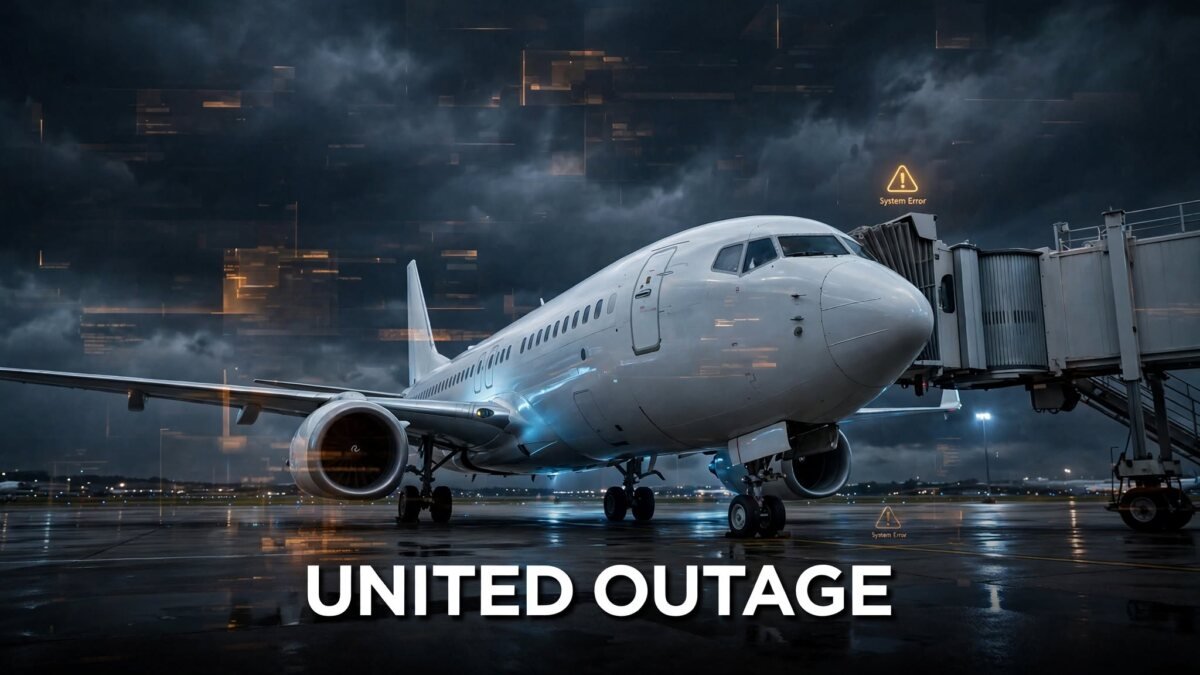
In the modern aviation industry, a plane cannot take off without a functioning computer system. And when those systems fail, the financial losses mount—but not always by the billions.
On November 16, 2026, United Airlines suffered a systemwide technology outage that lasted approximately 90 minutes to 1 hour and 40 minutes, forcing the airline to delay departing flights across its network. The disruption came just days after a separate, far larger nationwide ground stop caused by an FAA router failure, compounding a brutal week for US air travel.
Here is the ground reality of what actually happened, what it cost, and what it means for investors.
What Actually Caused the Outage
The draft’s speculation about “flight planning, crew scheduling, or ticketing” was close but not precise.
According to pilots who reported the issue to air traffic controllers, the problem was related to a system that helps them determine a plane’s final weight and balance. Before every departure, pilots use performance software—often on a cockpit tablet—to verify that the aircraft can safely take off under current weather and runway conditions. The calculations include the aircraft’s weight along with fuel, baggage, cargo, and passenger data.
Aviation safety expert Steve Arroyo, a former United pilot, explained: “It is extremely important to have all of these numbers accurate and precise. Pilots use that information to establish guidance and performance for their flights from takeoff to landing”.
United stated there was “no indication that this was a cybersecurity-related issue”. The airline resolved the issue by approximately 6 p.m. ET.
Important scope: The outage affected departing flights only. Flights already in the air and United Express regional flights were not affected.
The Financial Hit: Millions, Not Billions
The draft’s claim that an outage of this scale costs “$10 million to $50 million per day” is speculative. The actual estimate for this specific event, based on Bernstein’s analysis of the broader disruption week, is more precise.
The four largest US airlines faced a combined $345 million earnings hit from the FAA ground stop earlier in the week. United’s share of that was approximately $96 million, or $0.22 per share. That $96 million represented roughly 44% of the low end of United’s Q4 guidance range of $0.50 to $1.50 per share—material for a thin-margin business, but far from “billions”.
The reason the bill is millions rather than billions is a Department of Transportation rule: when a flight is canceled, passengers are entitled to a full refund, but airlines are not required to pay for hotels, meals, or cash compensation unless the cancellation was within the airline’s control. For the FAA-caused ground stop, the obligation was limited to refunds and rebooking.
For the United-specific outage on Monday, the direct cost is likely smaller—the outage lasted 90 minutes, affected only departing flights, and did not result in mass cancellations. United canceled 25 flights and delayed 645 on Monday, though not all of those disruptions were necessarily caused by the technology issue.
The Stock Reaction: A Modest Dip
The draft’s framing of “short-term volatility” is accurate, but the magnitude was modest.
United shares fell about 2.4% in postmarket trading after the outage was disclosed. By the time regular trading opened on Tuesday, however, the stock had recovered—United was trading up 2.79% at $112.36 as airline stocks broadly rebounded on expectations that operations would normalize.
The market’s muted reaction reflects a simple reality: a 90-minute outage that delays departing flights is an operational nuisance, not a structural crisis. Investors were far more focused on the broader FAA ground stop and the political fight over air traffic control funding that followed.
What Investors Should Actually Watch
1. The FAA Funding Fight
The United outage was a sideshow to the main event: the FAA’s aging infrastructure. Senate Majority Leader John Thune revealed that only $4 billion of the $12.5 billion approved by Congress for air traffic control modernization had been spent. Transportation Secretary Sean Duffy has requested $50 billion for upgrades, and the FAA is still using Compaq computers, floppy disks, and 25-year-old routers. This is the systemic risk that matters for airline stocks.
2. United’s Operational Resilience
United has now experienced two major tech failures in 15 months—the August 2025 Unimatic outage that grounded over 1,000 flights, and this week’s weight-and-balance system failure. If these become a pattern, passenger trust and regulatory scrutiny will follow.
3. The Q4 Guidance
United’s Q4 guidance of $0.50 to $1.50 per share is already under pressure from the FAA ground stop’s $0.22 hit. Watch whether the company adjusts its outlook when it reports earnings.
BS Maurya Research Verdict
The United Airlines outage was a real operational failure, but it was not the “massive global tech failure” the draft describes. It lasted 90 minutes, affected departing flights only, and was resolved without any indication of a cyberattack.
The financial cost is real—roughly $96 million from the broader disruption week, with a smaller incremental hit from Monday’s outage. But it is not “billions per day,” and the stock recovered within a day.
For investors, the lesson is not to panic-sell airline stocks over a single operational hiccup. The real risk in the aviation sector is the aging infrastructure that the FAA is still struggling to fund and fix. That is a systemic issue that will affect all airlines, not just United.
FAQ
Q1: What caused the United Airlines outage?
The outage was related to the system pilots use to calculate a plane’s weight and balance before departure. United said there was no indication of a cybersecurity issue.
Q2: How long did the outage last?
Approximately 90 minutes to 1 hour and 40 minutes. The issue was resolved by about 6 p.m. ET.
Q3: How much did the outage cost United?
Bernstein estimated United’s share of the broader FAA ground stop disruption at approximately $96 million, or $0.22 per share. The incremental cost of Monday’s 90-minute outage is likely smaller.
Q4: Did United’s stock crash?
No. United shares fell about 2.4% in postmarket trading after the outage, but recovered to trade up 2.79% on Tuesday as airline stocks rebounded.
Q5: Are refunds being given to passengers?
Under US DOT rules, passengers on canceled flights are entitled to a full refund if they choose not to travel. However, airlines are not required to pay for hotels or meals unless the cancellation was within their control.


