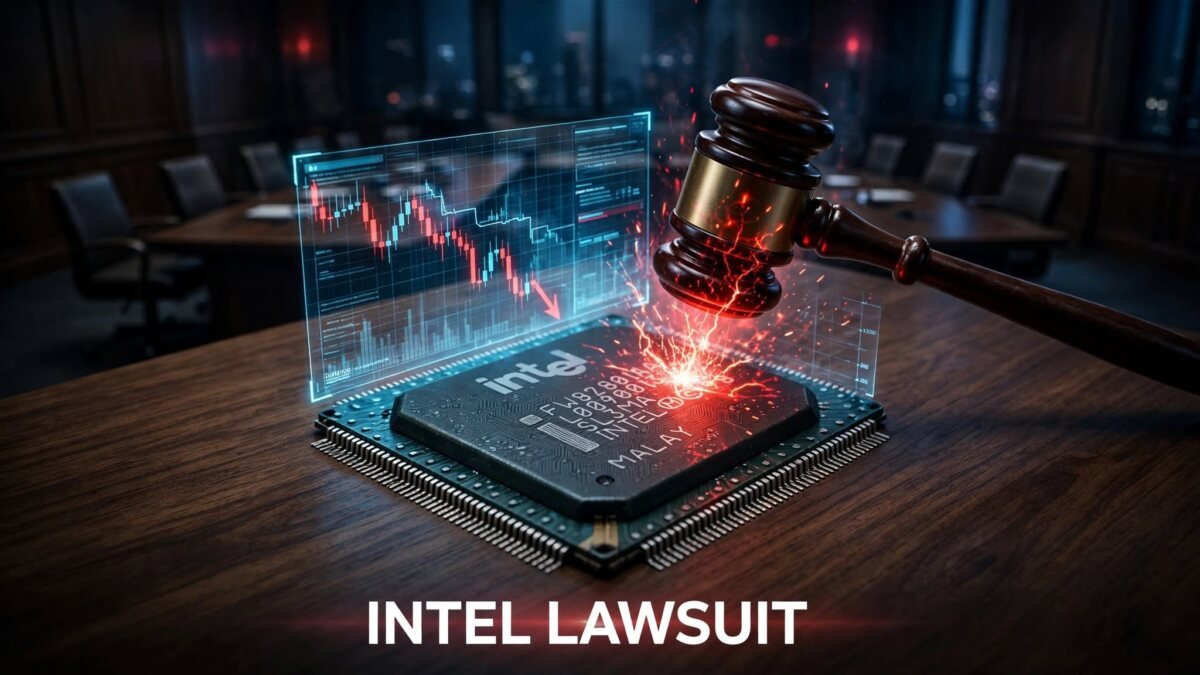
When a company’s stock price collapses, investors don’t just get angry—they call their lawyers. And right now, Intel’s lawyers are very busy.
Intel is facing a proposed class action lawsuit filed by shareholders in the San Jose, California federal court on November 13, 2026. The lawsuit alleges that Intel and its executives defrauded investors by concealing the impact of a prolonged slowdown in personal computer sales, which caused the stock to plummet 28.6% in a single day on October 30, 2026, wiping out approximately $140 billion in market value.
Here is the ground reality of what the lawsuit actually claims, why Intel is in trouble, and what it means for anyone holding semiconductor stocks.
The Core Allegation: Concealing the PC Slowdown
The draft’s focus on “foundry losses” and “18A delays” is not what the lawsuit is about. According to CNBC TV18’s report on the complaint, the shareholders—led by the City of Southfield Fire and Police Retirement System—allege that Intel was too slow to disclose information about how slowing PC sales and an inventory glut would weigh on revenue.
The specific allegations are:
Concealment of the slowdown: Intel executives downplayed the severity of the PC market deterioration. The company projected confidence while, according to the complaint, the reality was far worse.
The $23 billion stock sale: The lawsuit alleges Intel had the motive and opportunity to defraud by raising capital in mid-August 2026, halfway through what the complaint calls a “disastrous” third quarter. Intel sold $23 billion of stock at $95 per share while, according to the plaintiffs, insiders knew the PC slowdown would hit revenue.
The crash: On October 29, Intel projected lower-than-expected fourth-quarter revenue and profit and forecast a prolonged PC slowdown. The next day, the stock fell 28.6%.
The proposed class covers shareholders who bought Intel stock between July 23, 2026, and October 29, 2026. The defendants include CEO Lip-Bu Tan and CFO David Zinsner.
What the Draft Got Wrong
The draft’s narrative is built on a different lawsuit—or a misreading of this one. Here are the key errors:
Wrong CEO: The draft repeatedly refers to “Pat Gelsinger” as Intel’s CEO. Gelsinger was ousted and replaced by Lip-Bu Tan as CEO. Tan is the one named in the lawsuit.
Wrong allegations: The draft claims the lawsuit is about “foundry losses” and “18A delays.” The actual complaint centers on PC sales and inventory, not foundry profitability.
Outdated spin-off framing: The draft says Intel “has recently hinted at spinning off its Foundry business.” In November 2026, Intel announced the foundry would become a subsidiary, not a spin-off. Gelsinger (before his departure) said the subsidiary structure would provide “clearer separation and independence” and future flexibility, but a full spin-out was only a possibility, not a plan.
Wrong stock price context: The draft says Intel “has lost more than half its value in the last few years.” Intel stock is actually up 62% in 2026 through November 13, though it has fallen from its June peak of $142.35 to $59.66.
The Real Foundry Picture (For Context)
The draft’s obsession with foundry losses is not entirely irrelevant to Intel’s story—it is just not what this lawsuit is about.
In Q3 2026, Intel Foundry reported revenue of $6.7 billion, up 16% sequentially, but an operating loss of $1.9 billion. External foundry revenue was only $411 million, highlighting the challenge of attracting outside customers.
The foundry’s problems are real. But the stock crash that triggered the lawsuit was driven by the PC business, not the foundry. Intel’s Client Computing Group revenue declined 9% sequentially to $8.1 billion, and the company guided Q4 revenue to $15–16 billion—well below consensus of $17.07 billion—citing PC inventory correction and underutilization.
The Broader Risk: Corporate Governance
For investors, the Intel lawsuit is a stark reminder of corporate governance risk.
A lawsuit of this magnitude can distract management, trigger SEC scrutiny, and cost billions in settlements. The fact that Intel raised $23 billion in capital just months before the crash is the central vulnerability—plaintiffs will argue that insiders knew the PC slowdown was worsening and rushed to raise money before the bad news became public.
Whether that argument prevails in court is a separate question. But the reputational damage is already done.
What Should Investors Watch?
1. The Foundry Subsidiary Structure
Intel’s decision to make Foundry a subsidiary—announced in November 2026—is a significant structural change. Watch how the lawsuit impacts this process and whether it delays any future funding or spin-out plans.
2. The PC Recovery Timeline
The lawsuit hinges on when Intel knew about the PC slowdown. Any evidence that executives were aware of deteriorating conditions earlier than disclosed will strengthen the plaintiffs’ case. Watch for depositions and internal documents.
3. The Balance Sheet
Intel ended Q3 with $54 billion in cash and short-term investments and $15 billion in borrowing capacity. A settlement would be painful but not existential. The bigger risk is the distraction and the precedent it sets for future disclosure practices.
BS Maurya Research Verdict
Intel’s legal battle is a symptom of a company that lost its way—but the specific disease is different from what the draft describes.
This lawsuit is not about the foundry gamble or 18A delays. It is about whether Intel’s leadership concealed the severity of a PC downturn while raising $23 billion from investors. That is a disclosure and governance issue, not a technology issue.
For investors, Intel remains a deep-value turnaround play under new CEO Lip-Bu Tan. The stock is cheap, but it is cheap for a reason: the foundry is losing billions, the PC business is contracting, and now the company faces a class action that will consume management attention and potentially cost billions.
Do not catch the falling knife unless you have a very long investment horizon and a high risk tolerance. And do not confuse this lawsuit with the foundry story—they are related, but they are not the same.
FAQ
Q1: Why are Intel shareholders suing the company?
Shareholders allege that Intel concealed the impact of a prolonged PC sales slowdown and inventory glut, while raising $23 billion in capital in mid-August 2026. When Intel disclosed weak Q4 guidance on October 29, the stock fell 28.6% the next day.
Q2: Is Pat Gelsinger (Intel CEO) named in the lawsuit?
No. Gelsinger is no longer Intel’s CEO. The defendants are CEO Lip-Bu Tan and CFO David Zinsner.
Q3: Does this mean Intel is going bankrupt?
No. Intel still generates massive revenues from its PC and server chip businesses, and ended Q3 with $54 billion in cash. The lawsuit is a serious financial and reputational hit, but it is not an extinction-level event.
Q4: Should I buy Intel stock now?
Intel is a speculative turnaround play. The foundry is still losing money, the PC market is weak, and the legal overhang is real. If you believe in Lip-Bu Tan’s strategy and have a long horizon, it might be a buy. But the risks are very high.
Q5: What is the foundry subsidiary structure?
Intel announced in November 2026 that its foundry business would become a subsidiary, providing clearer separation from the rest of Intel and future flexibility for funding. It is not a full spin-off


