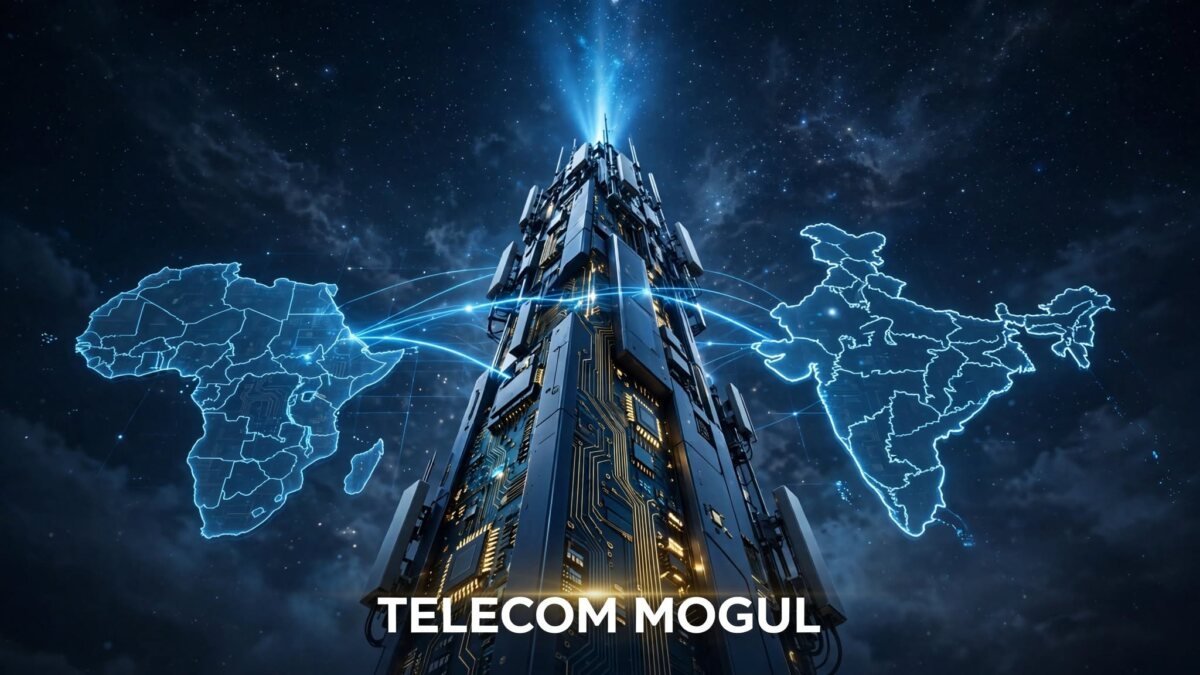
In the Indian telecom sector, there are businessmen, and then there is Sunil Bharti Mittal. As the founder and chairman of Bharti Airtel, he has built an empire that connects hundreds of millions of people across India and Africa.
Whenever Sunil Mittal makes a move or a statement, the market listens. Searches for his name spiked in mid-November 2026 after a series of candid interviews marking Bharti Enterprises’ 50th year, in which he laid out an unusually blunt case for higher tariffs, a sharper critique of 5G economics, and a muscular vision for India’s satellite and AI infrastructure future.
Here is the ground reality of Sunil Mittal’s current strategy and what it means for the future of India’s digital economy.
The 5G Monetization Challenge: Mittal Wants ₹350, Not ₹300
Bharti Airtel was the first to launch 5G in India and has aggressively rolled it out across the country. However, the telecom industry is facing a harsh truth: 5G is expensive, and consumers are not yet willing to pay a premium for it.
Mittal has been very vocal about this. In a PTI interview in November 2026, he argued that Indian mobile tariffs should rise to about ₹350 per month per user—roughly ₹10–12 per day—to fund the massive infrastructure still needed.
Crucially, he explicitly revised his own long-standing target. “I used to say earlier, the right level is ₹300 (monthly revenue per user), but that was 10 years back,” he said. “There’s some inflation that we all suffer”. The draft’s ₹300 figure is outdated.
The Ground Reality: Airtel’s mobile ARPU was ₹271 in the September quarter (Q2 FY27), up from ₹256 a year earlier. A move to ₹350 would represent roughly a 29% increase. Mittal rested his argument on two pressures: rising network operating costs (oil, electricity, employee, administrative) and the infrastructure backlog. “China has over a million towers. India has about 350,000. So we have a job to do. We have to at least double from where we are today,” he said.
He also called the revenue outcome from 5G “a bit of a disappointment,” noting that spectrum cost operators “lakhs of crores” and the network build took another “lakh and a half crores,” without the expected new revenue.
The Satellite Internet Race: OneWeb vs. Starlink
While the world talks about Elon Musk’s Starlink entering India, Sunil Mittal has positioned Airtel’s satellite venture, Eutelsat OneWeb, as the frontrunner.
At the Bloomberg New Economy Forum in October 2026, Mittal said OneWeb was “significantly ahead” of Starlink in the queue for operational approval. “I applied five years back,” he said. “We don’t have the permission, so we’ll be very happy to get it at least a few days before him”.
The Regulatory Nuance: The draft’s framing of an “ambush” overstates the clarity of the race. Three companies—OneWeb, Reliance’s Jio Satellite Communications, and Starlink—have secured satellite communications licences. But a licence does not automatically permit commercial operations. Spectrum assignment and compliance with security requirements remain necessary before services can launch. Mittal said OneWeb’s ground network has been ready for three years and its satellites have been hovering over India for five years, but the company is still awaiting the government’s signal.
Mittal has also called for India to retain control over the “kill switch” for satellite communications operating in the country, warning against dependence on a single foreign provider. “The kill switch, as we call it, should not be sitting somewhere else. India must have control over its own space destiny,” he said.
The Global Empire: Africa Remains a Growth Engine
What many Indian investors forget is that Bharti Airtel is not just an Indian company. Airtel Africa delivered a standout performance in FY26, with revenue growing 24.0% in constant currency to $6,415 million and underlying EBITDA margins reaching an all-time high of 50.3% in Q4. The customer base grew 10.5% to 183.5 million, with data customers up 14.8% to 84.2 million.
Mittal’s ability to raise capital and manage operations in volatile African markets is a testament to his business acumen. This geographic diversification protects Airtel from localized economic shocks in India.
The Next Frontier: AI and Data Centers—The $1 Billion Bet
The draft’s framing of Airtel’s AI ambitions is directionally correct but misses the most concrete development: the $1 billion investment in Nxtra, Airtel’s data center subsidiary.
In March 2026, Airtel announced that Alpha Wave Global, Carlyle, and Anchorage Capital would invest $1 billion in Nxtra, with Airtel also participating. The deal valued Nxtra at approximately $3.1 billion post-closing, with Airtel retaining a controlling stake.
Nxtra currently operates 14 large core data centers and 120+ edge facilities, with roughly 300 MW of capacity. The plan is to scale to 1 GW in the next few years, targeting approximately 25% market share. Nxtra has also partnered with Google to build a gigawatt-scale AI data center campus, backed by a $15 billion investment.
CLSA noted that Nxtra’s rapid expansion could strengthen Airtel’s enterprise business and potentially enhance the valuation of its India operations, estimating India’s data center capacity requirement will rise to 4.7–5.7 GW by FY30.
What Should Investors Watch?
1. ARPU Growth: The single most important metric for Airtel. If tariffs move toward ₹350, the company’s free cash flow could rise significantly. But Mittal gave no timeline for the increase, saying only “I don’t know” when asked when the industry would reach that level.
2. The Satellite Approval Race: Watch whether OneWeb or Starlink receives operational clearance first. Mittal’s public lobbying suggests he believes Airtel’s first-mover application gives it an edge, but the government has maintained that all operators must meet the same security requirements.
3. Nxtra’s Execution: The $1 billion investment and Google partnership are ambitious. Watch whether Nxtra can scale to 1 GW and capture the AI data center demand CLSA expects.
BS Maurya Research Verdict
Sunil Mittal is a survivor and a visionary. He built Airtel from scratch and navigated the brutal Indian telecom market when competitors like Vodafone Idea are still struggling to survive.
For investors, Bharti Airtel represents a stable, long-term play on India’s digital growth. Mittal’s conservative approach to pricing and his aggressive push into enterprises, satellites, and data centers make Airtel one of the most fundamentally sound companies in the market. The ₹350 tariff ask is aggressive, but it reflects a genuine infrastructure funding gap rather than pure greed. The OneWeb and Nxtra bets are real options on future growth that the market has not fully priced.
It is not a “get-rich-quick” stock, but it is a wealth-compounder for the patient investor.
FAQ
Q1: Who is Sunil Mittal?
He is the founder and chairman of Bharti Enterprises, which owns Bharti Airtel, one of India’s largest telecom operators and a major global player with operations across India and Africa.
Q2: Why is Airtel focusing on raising tariffs?
Mittal argues that low tariffs have damaged the financial health of the telecom sector. He is now advocating for a ₹350 monthly average—up from his earlier ₹300 target—to fund the massive capital expenditure required for 5G, AI, and doubling India’s tower infrastructure.
Q3: What is Airtel’s satellite internet plan?
Airtel has partnered with Eutelsat OneWeb to provide satellite broadband services in India. OneWeb has a licence but is awaiting operational approval, and Mittal says it is ahead of Starlink in the queue.
Q4: What is Nxtra, and why does it matter?
Nxtra is Airtel’s data center subsidiary. It raised $1 billion from Alpha Wave Global, Carlyle, and Anchorage Capital in March 2026, valuing it at $3.1 billion. It plans to scale from ~300 MW to 1 GW of capacity, capitalizing on India’s AI and cloud computing boom.
Q5: Is Bharti Airtel a good long-term investment?
Airtel has strong fundamentals, a healthy balance sheet compared to peers, and a clear strategy for growth across mobile, enterprise, satellite, and data centers. It is a solid, stable investment for the long term, though the pace of tariff increases and satellite approvals will determine the near-term upside.


