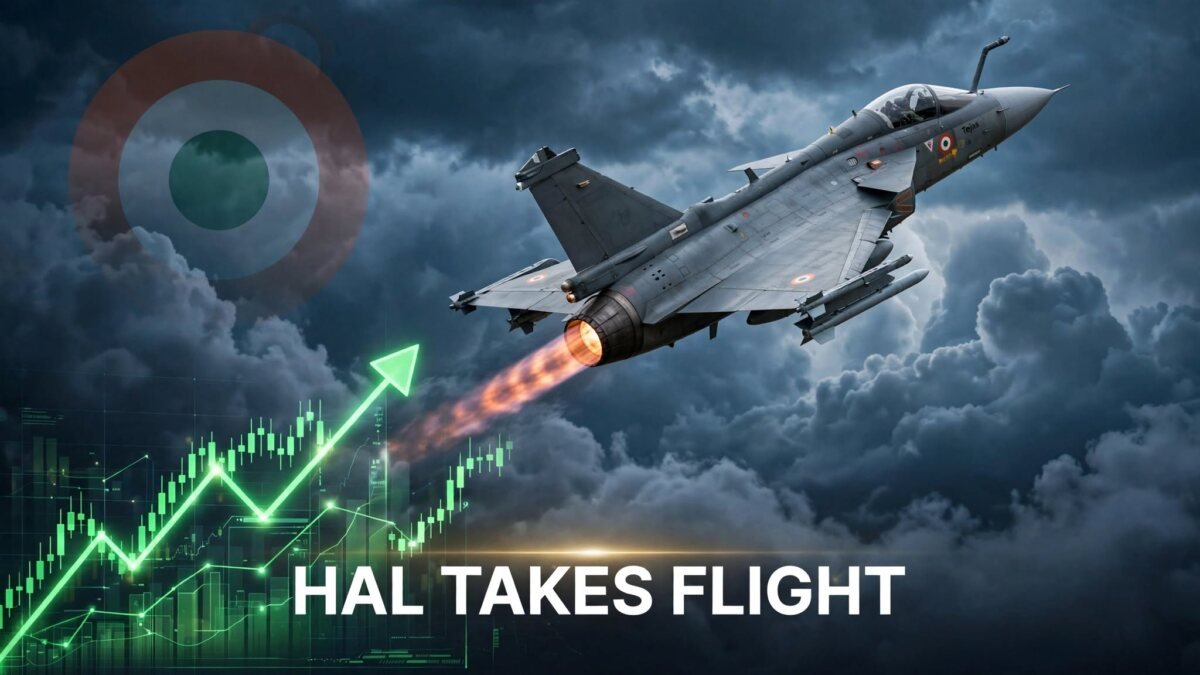
Hindustan Aeronautics Limited (HAL) is not just a stock. It is the backbone of India’s military aviation. And right now, it is one of the most closely watched defence PSUs in the market.
On November 13, 2026, HAL shares were trading around ₹4,858, up 0.3%. But the real story is what brokerages are saying after the company’s Q2 FY27 results. Several analysts have recently raised their target prices, with the most bullish estimates reaching ₹6,350 per share.
Why is the street so optimistic about a government-owned aerospace company? The answer lies in the order book, the geopolitical reality, and the shift toward indigenous manufacturing—even as execution remains the key risk.
The Q2 Reality: Revenue Grew, But Margins Missed
HAL’s Q2 FY27 results, reported on November 12, were a mixed bag. The top line beat expectations, but operating profitability disappointed.
Consolidated revenue: ₹7,613 crore, up 14.9% year-on-year.
Consolidated net profit: ₹1,936 crore, up 16% year-on-year, largely in line with estimates.
EBITDA: ₹1,739 crore, up 11.6%, but EBITDA margin contracted to 22.8% from 23.5% a year earlier, missing street estimates.
The margin miss was driven by lower gross margins, potentially due to an unfavourable product mix. HSBC noted that EBITDA margin declined 70 basis points year-on-year to 22.8%.
A positive signal: HAL’s inventory rose sharply—around 28% in H1 FY27—which analysts interpret as a build-up of LCA Mk1A airframes ahead of deliveries.
The Order Book: ₹2.5 Lakh Crore of Visibility
HAL’s order book stands at approximately ₹2.5 lakh crore, providing multi-year revenue visibility. This includes orders for Light Combat Aircraft (LCA) Tejas Mk1A, Light Combat Helicopters (LCH) Prachand, and engines for various platforms.
Nomura highlighted healthy order visibility, supported by a manufacturing book-to-bill ratio of around 25 times. JPMorgan and Kotak both put the near-term order pipeline at approximately ₹900 billion over the next two years.
The Tejas Factor: The Game Changer (If It Delivers)
The biggest catalyst for HAL is the Tejas Mk1A program. The Indian Air Force has ordered 180 aircraft in two contracts: 83 in 2021 and 97 in 2025.
The critical bottleneck has been GE F404 engine supply. That is finally improving. GE shipped four engines in September 2026, taking cumulative deliveries to 14. HSBC expects LCA Mk1A deliveries to commence by the end of FY27. Prabhudas Lilladher noted that approximately 27 airframes have been built and are awaiting final testing, with ~10 aircraft targeted for IAF delivery by March 2027.
But execution remains the key risk. The Tejas program is years behind its original schedule. The IAF chief has publicly acknowledged that “the delay has been much”. If HAL fails to deliver on time, it could face financial penalties.
The Brokerage View: Targets Up to ₹6,350
The post-results brokerage notes are decisively positive, with targets ranging from ₹5,410 to ₹6,350:
HSBC: Buy, target ₹6,350. Expects Tejas Mk1A deliveries to begin by end-FY27 as engine supply and integration issues resolve.
Nomura: Buy, target ₹6,314. Describes Q2 operating performance as steady, with healthy order visibility.
Citi: Buy, target ₹6,175. Cites the delivery ramp and improving execution readiness.
Goldman Sachs: Buy, target ₹5,870. Points to improving GE F404 engine supplies and higher helicopter deliveries.
Prabhudas Lilladher: Buy, target ₹5,943. Values the stock at 35x Sep’28E earnings.
UBS (the outlier): Sell, target ₹3,650 (raised from ₹3,200). Cites limited visibility on incremental large platform orders through FY28 and rising private sector competition.
The consensus is clear: the order book is not in dispute. The disagreement is about execution timing and what happens after the current order book is exhausted.
The Geopolitical Tailwind: Export Potential
India has historically been the world’s largest importer of defence equipment. But the government’s “Make in India” push is changing that dynamic.
HAL is now actively pitching the Tejas to friendly foreign nations. Prabhudas Lilladher noted expanding export initiatives across Africa, the Middle East, and Southeast Asia as providing additional growth opportunities. If HAL secures even one major export order for the Tejas, it would be a significant re-rating trigger.
The Risks: Why Investors Must Be Careful
1. Execution Delays: This is HAL’s biggest historical flaw. The Tejas program is years behind schedule. The IAF chief has publicly flagged the delay, and the Defence Ministry has considered penalties.
2. Margin Pressure: EBITDA margin contracted to 22.8% in Q2, below management’s full-year target of 30-31%. The manufacturing mix will determine whether margins recover.
3. Valuation: At a P/E of around 30x FY28 earnings, HAL is no longer cheap. UBS’s Sell rating reflects concern that the current order book does not guarantee the next one.
4. Technology Transfer: HAL relies heavily on foreign engine manufacturers (like GE) for the Tejas. Any disruption in the global supply chain can halt production.
BS Maurya Research Verdict
HAL is a strategic asset for India. It is the only company that can build, repair, and maintain the country’s fighter jets. The current government’s focus on defence indigenization provides a multi-decade growth runway, and the ₹2.5 lakh crore order book offers genuine revenue visibility.
However, the Q2 margin miss is a reminder that execution is not guaranteed. The brokerage targets of ₹5,870–₹6,350 are achievable if Tejas deliveries accelerate and engine supply remains smooth. But the stock is not cheap at 30x forward earnings, and UBS’s ₹3,650 Sell target shows that not everyone is convinced.
For long-term investors, HAL remains a core defence holding. Any dip due to execution delays should be viewed as an opportunity—but position sizing matters, because the path to ₹6,000+ will not be a straight line.
FAQ
Q1: Why are brokerages bullish on HAL share price?
Brokerages are bullish due to HAL’s massive ₹2.5 lakh crore order book, the expected increase in Tejas fighter jet deliveries as GE engine supply improves, and the company’s high profit margins relative to peers. HSBC has the highest target at ₹6,350.
Q2: What is the biggest growth driver for HAL?
The Tejas Mk1A program and the development of the AMCA (Advanced Medium Combat Aircraft) are the biggest long-term growth drivers. Near-term, the commencement of Tejas Mk1A deliveries—expected by end-FY27—is the key catalyst.
Q3: What was HAL’s Q2 FY27 net profit?
Consolidated net profit was ₹1,936 crore, up 16% year-on-year from ₹1,669 crore. Revenue grew 14.9% to ₹7,613 crore. However, EBITDA margin contracted to 22.8% from 23.5%, missing estimates.
Q4: What is the biggest risk for HAL?
Execution delays. The Tejas program is years behind schedule, and the IAF chief has publicly acknowledged the delay. If HAL fails to deliver aircraft on time, it could face penalties and impact future defence contracts.
Q5: Does HAL pay dividends?
Yes, HAL is a highly profitable PSU and has a consistent track record of paying generous dividends to its shareholders.