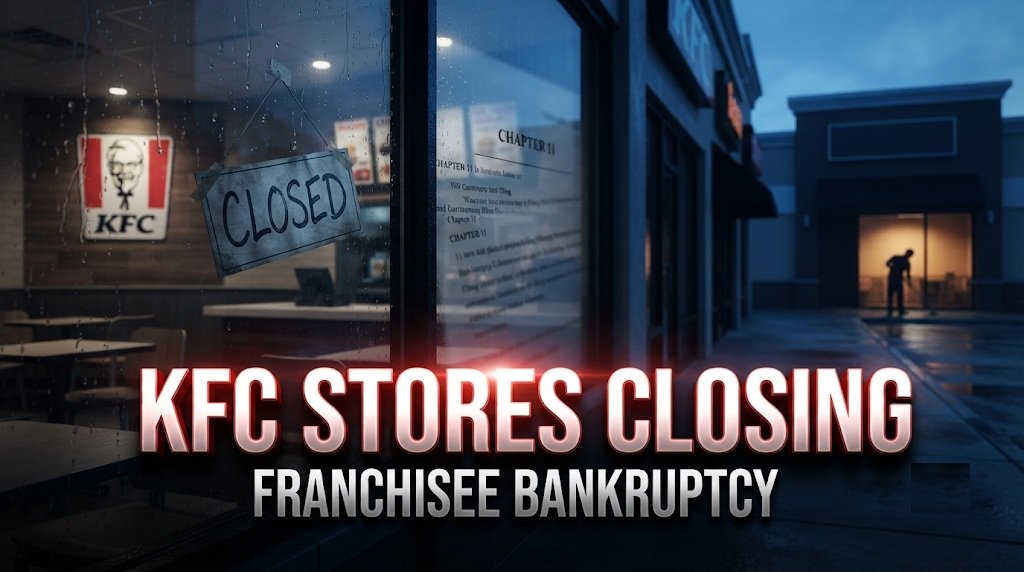
Dozens of KFC restaurants across ten US states have closed or are set to close after franchisee Tasty Chick’n LLC filed for Chapter 11 bankruptcy protection on Monday, citing sliding sales and more than $15.6 million in unpaid royalties owed to Yum Brands. The Texas-based operator, which owns 75 KFC locations and nine KFC/Taco Bell co-branded restaurants, is now fighting to keep its remaining stores open while it attempts a court-supervised sale—and the collateral damage is already visible on the ground.
The company has asked the court to reject leases at 72 locations that have either already shut down or are winding down operations, according to filings. The reported breakdown of closures in the lead-up to the filing includes Tennessee with 19, Florida with 10, Arkansas with 9, and Virginia and Kentucky with 7 each. Separately, court documents identify nine specific locations where Tasty Chick’n is exiting leases during the bankruptcy proceedings, including three in Memphis and three in Kentucky. The chain’s presence in several communities is simply disappearing.
Why a Franchisee With 84 Locations Collapsed
Tasty Chick’n was created in 2021 specifically to acquire and operate KFC and Taco Bell restaurants under franchise agreements with Yum Brands. Less than five years later, it is in bankruptcy court. The company’s CEO, Thomas C. Scott, laid out the arithmetic in stark terms: rising food, labor, operating, and rent costs have crushed profitability, while the franchise agreement itself imposed “substantial remodel and upgrade obligations” that the operator could not fund.
The breaking point came on September 15, 2026, when Yum Brands served notice of intent to terminate the franchise agreements over the unpaid royalties. Tasty Chick’n’s Chapter 11 filing is, in effect, a defensive maneuver—a way to freeze the termination and buy time to sell the restaurants rather than lose everything immediately.
The financial picture is ugly. Tasty Chick’n and its affiliates report assets between $50 million and $100 million, against liabilities ranging from $100 million to $500 million. That is a balance sheet underwater by at least a 1:1 ratio, and potentially far worse depending on where the true liabilities land within that range. The franchisee also entered bankruptcy with nearly $73 million in funded debt.
The Brand Damage Problem Yum Brands Cannot Ignore
Yum Brands has not commented publicly on the bankruptcy beyond court filings, but an affiliate’s warning is already on the record: sudden store closures could cause “significant harm to the KFC brand,” potentially causing KFC to “go dark” in select markets and eroding consumer confidence in those communities.
That phrase—“go dark”—is the one that should concern every YUM shareholder. A franchisor’s asset is not the real estate or the equipment. It is the brand’s ubiquity. Every dark storefront is a reminder to consumers that the chain is shrinking, and every shrinking chain faces a harder time attracting new franchisees to take over the failed locations.
The closures are not evenly distributed. Kentucky—the state that gave KFC its name and its identity—is losing seven locations before the bankruptcy filing and three more during the proceedings. There is a symbolic cost to that beyond the revenue line.
What This Means for the Franchise Model Itself
Tasty Chick’n’s failure is not an isolated case of mismanagement. It is a stress test of the franchise model under conditions that have become brutal for restaurant operators: food inflation, wage pressure, rent escalation, and franchisor-mandated capital spending that does not generate proportional returns.
The franchise agreement required remodels and upgrades at nearly 40 restaurants through 2029. Yum Brands wanted the brand standards maintained. Tasty Chick’n could not afford to comply, stopped paying royalties, and ultimately chose bankruptcy over termination. The lesson for anyone evaluating franchise investments—whether in restaurants or any other sector—is that the franchisor’s brand standards are a fixed cost the franchisee must bear, regardless of whether the local market can support it.
For Yum Brands, the immediate financial exposure is contained. The unpaid royalties are a write-off, not a liquidity crisis. But the precedent matters. If other franchisees face similar pressure—and the industry-wide conditions suggest many do—Yum and its peers may face a wave of renegotiation demands or additional failures. Notably, this filing follows Encanto Restaurants’ Chapter 11 in Puerto Rico, another KFC franchisee failure.
Key Metrics: The KFC Franchisee Collapse in Numbers
| Metric | Detail |
|---|---|
| Franchisee | Tasty Chick’n LLC (Plano, Texas-based) |
| Total Locations Owned | 75 KFC + 9 KFC/Taco Bell co-branded (84 total) |
| States Affected | 10 (TN, FL, AR, VA, KY, AL, IL, MO, MS, IN) |
| Leases Being Rejected | 72 locations (already closed or winding down) |
| Additional Lease Exits in Bankruptcy | 9 specific locations identified in court filings |
| Unpaid Royalties | $15.6 million+ owed to Yum Brands |
| Assets vs. Liabilities | $50–100M assets / $100–500M liabilities |
| Funded Debt | ~$73 million |
BS Maurya Research Verdict
Yum Brands investors should not panic-sell on this headline, but they should watch the franchisee health metric closely. The Tasty Chick’n bankruptcy represents a small fraction of KFC’s 35,000+ global units, and the company’s diversified portfolio (Taco Bell, Pizza Hut, Habit Burger) limits the damage from any single franchisee failure.
The real risk is contagion of confidence. If additional KFC franchisees file for protection in the coming quarters, the market will begin pricing in a broader brand erosion scenario. That is not the base case today, but the conditions that killed Tasty Chick’n—cost inflation and mandatory capital spending—are not unique to this operator.
For investors interested in the franchise model as a category, this bankruptcy is a case study in the asymmetry of franchise risk: the franchisor collects royalties and brand fees with limited downside, while the franchisee absorbs the full operating risk. The franchisee’s bankruptcy is the franchisor’s write-off. That asymmetry is why YUM remains a fundamentally sound business even when its operators fail. The stock is not cheap enough to chase on this news, but it is not a sell.
FAQ
1. How many KFC stores are closing due to the Tasty Chick’n bankruptcy?
Tasty Chick’n has asked the court to reject leases at 72 locations that have already closed or are winding down operations. Separately, court documents identify nine specific locations where the company is exiting leases during bankruptcy proceedings. The total could rise as the court-supervised sale process unfolds.
2. Which states are losing the most KFC locations?
Tennessee has the most closures (19 pre-filing), followed by Florida (10), Arkansas (9), and Virginia and Kentucky (7 each).
3. Is Yum Brands going bankrupt or losing KFC?
No. Yum Brands is the franchisor, not the franchisee. Tasty Chick’n is an independent operator that owes Yum $15.6 million in unpaid royalties. Yum’s financial exposure is limited to that write-off and any brand damage from the closures.
4. Why did Tasty Chick’n file for bankruptcy?
The franchisee cited sliding sales, rising food and labor costs, rent increases, and mandatory remodel obligations under its franchise agreement. Sales declined approximately 15.6% over three fiscal years, and profit margins fell from 11.8% in 2023 to 4% in 2026. It filed Chapter 11 to prevent Yum from terminating the franchise agreement immediately.
5. Will more KFC franchisees go bankrupt?
There is no public indication of imminent additional filings, but industry-wide cost pressures affect all restaurant franchisees. A separate KFC franchisee in Puerto Rico, Encanto Restaurants, recently filed for Chapter 11 as well. Yum Brands has not disclosed the financial health of its remaining operator base.