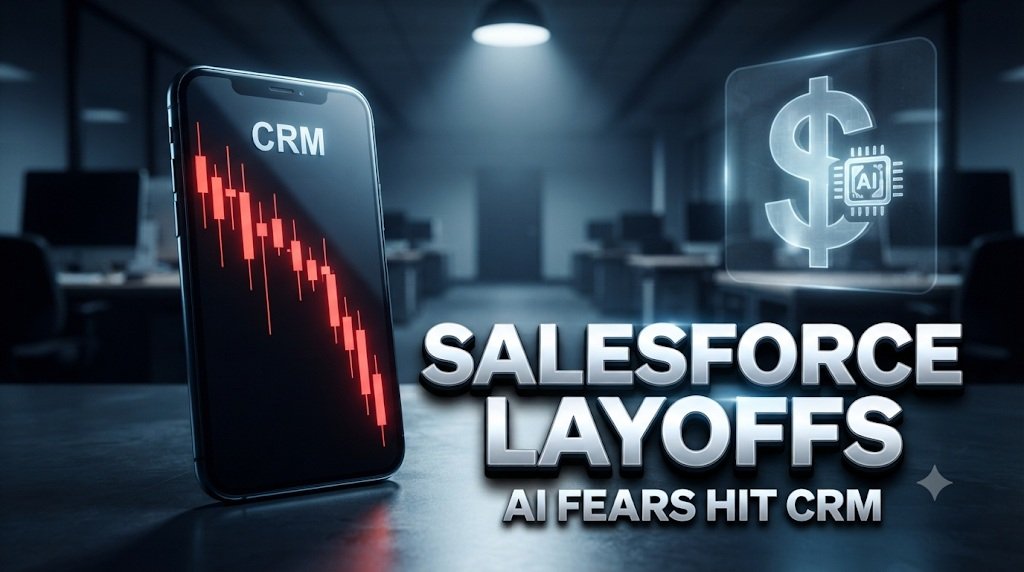
Salesforce has launched another round of layoffs in November 2026, with employees across multiple teams in the US and India reportedly affected, while the company simultaneously introduced monthly spending budgets for employee AI tool usage. The stock has fallen roughly 10% this week—on track for its steepest weekly decline since April—as investors grapple with an uncomfortable question: if Salesforce is limiting its own AI spending, what does that signal for the entire enterprise software AI narrative?
The layoffs were first disclosed through internal Slack discussions and LinkedIn posts from affected employees. A senior manager in IT compliance and content strategy confirmed that they and several team members were let go on Monday morning. The exact number of affected employees remains undisclosed, but the pattern is unmistakable—Salesforce has now conducted at least three distinct workforce reductions in 2026 alone: fewer than 1,000 roles in January, 86 positions in California in August, and this latest round in November.
The India Dimension: Garden Leave Until February 2027
For Salesforce’s substantial Indian workforce, the reported layoff terms offer a revealing window into how the company may be structuring exits. Anonymous posts on workplace forum Blind describe affected Indian employees being placed on garden leave until February 1, 2027, with severance packages that could reach approximately 21 weeks depending on tenure and location. These terms have not been officially confirmed by Salesforce and should be treated as unverified employee accounts.
Garden leave means the employee remains on payroll but is not required to report to work during the notice period—a mechanism that keeps the departing worker technically employed while preventing access to sensitive systems or clients. For Salesforce, this approach achieves two objectives: it satisfies contractual notice obligations while neutralizing any competitive or data risk. For affected employees in India, the practical reality is a paid transition period extending well into the next calendar year, but with the psychological burden of knowing the employment relationship is already over.
The India layoffs matter disproportionately for Salesforce’s cost structure. The company has significant operations in Hyderabad and Bengaluru, and the rupee-denominated salary base makes Indian roles an attractive target when US-headquartered firms need to demonstrate expense discipline to Wall Street. The absence of official confirmation from Salesforce does little to dampen the signal: when anonymous forums light up with specific garden leave dates, the cuts are likely real.
The AI Spending Budgets That Should Worry Investors More Than the Layoffs
Buried beneath the layoff headlines is a more consequential detail for anyone holding CRM stock: Salesforce has introduced monthly spending budgets for employees using AI tools, after some workers reportedly burned through thousands of dollars on AI tokens in the previous quarter.
Under the structure outlined in an internal memo, technical employees in the sales organization receive a monthly AI budget of $1,000, while non-technical employees including sales staff receive $100. Customer Success and Professional Services teams have budgets of $500 for technical roles and $100 for non-technical roles. A Salesforce spokesperson clarified that the company does not have universal individual token budgets, leaving AI usage management to team leaders.
Read that again. A company that has staked its entire forward narrative on Agentforce—its AI agent platform—is now placing guardrails on how much its own employees can spend on AI tools because the bills got too high. This is not a cost-control footnote. It is a direct signal that the unit economics of enterprise AI consumption remain challenging at scale, even for the company selling the AI.
CEO Marc Benioff has pushed back aggressively against what he calls the “Saaspocalypse” narrative—the fear that AI will cannibalize traditional SaaS revenue models. During the last earnings call, he dismissed concerns about a broader software demand collapse. But the market is not buying the rhetoric. Salesforce shares dropped approximately 9% on Tuesday alone before a modest overnight bounce. The weekly decline of roughly 10% represents the most severe punishment the stock has absorbed since April, and it comes despite no catastrophic earnings miss or guidance cut.
The market is pricing a structural fear, not a quarterly miss. If Salesforce—the dominant CRM vendor with over 150,000 customers—cannot demonstrate that Agentforce is generating incremental revenue at acceptable margins, the entire premise that legacy software incumbents will successfully monetize the AI transition comes into question. The AI spending budgets are the first concrete evidence that even the sellers are grappling with the cost side of that equation.
Key Metrics: Salesforce’s 2026 Workforce and Market Performance
| Metric | Detail | Investor Implication |
|---|---|---|
| 2026 Layoff Rounds | January (<1,000), August (86 CA roles), November (undisclosed) | Pattern of rolling reductions, not one-time restructuring |
| Stock Weekly Decline | ~10% (steepest since April 2026) | Market pricing AI margin uncertainty |
| AI Spending Policy | Role-based monthly budgets ($100–$1,000/month) | Cost discipline signals margin pressure in AI products |
| India Exit Terms | Garden leave until Feb 1, 2027; ~21 weeks severance claims (unverified) | Labor cost arbitrage in restructuring |
| Braze Acquisition | $5.66 billion proposed deal | Debt and integration risk amid layoffs |
| US Severance (reported) | Up to 30 weeks base pay (tenure/level dependent) | Standard policy, not enhanced package |
What the Braze Deal Reveals About Salesforce’s Priorities
The proposed $5.66 billion acquisition of Braze, a customer engagement platform, has raised separate questions about capital allocation discipline. Salesforce is cutting headcount while simultaneously committing billions to an acquisition that expands its marketing technology footprint. The strategic logic—integrating Braze’s real-time customer data capabilities with Salesforce’s CRM and Agentforce stack—is defensible on paper. But the timing is awkward.
Investors are being asked to accept near-term margin degradation from both the layoff severance costs and the Braze integration expenses, while waiting for Agentforce revenue to materialize at scale. That is a patience trade that the market is increasingly unwilling to make. The roughly 10% weekly decline is not a verdict on Salesforce’s long-term franchise; it is a signal that the market wants proof, not narrative.
BS Maurya Research Verdict
Salesforce remains the bellwether for enterprise software’s AI transition, and this week’s price action reflects genuine uncertainty rather than irrational panic. The layoffs themselves are not the story—rolling workforce reductions have become standard operating procedure across mega-cap tech in 2026. The story is the AI spending guardrails.
For retail investors holding or considering CRM, the key question is not whether Salesforce can cut costs (it clearly can), but whether Agentforce can generate revenue growth that justifies the premium multiple the stock has historically commanded. The company has not yet demonstrated that AI agents are driving net-new customer spend rather than cannibalizing existing license revenue.
Our view: patience is warranted, but position sizing should reflect the binary risk. If Agentforce data in the next two quarters shows accelerating attach rates and expanding average contract values, the current drawdown could be a generational entry point into a franchise with unmatched enterprise distribution. If the data shows AI monetization stalling, the stock has further to fall despite the layoffs. The AI spending budgets are a yellow flag, not a red one—but they deserve close monitoring. Investors with a multi-year horizon can begin scaling into weakness. Traders should wait for stabilization above the weekly low.
FAQ
1. How many Salesforce employees were laid off in November 2026?
Salesforce has not disclosed the exact number. Employees across multiple teams in the US and India have confirmed cuts through internal channels and public posts, but the total scale remains unconfirmed as of November 19, 2026.
2. What severance are Indian Salesforce employees receiving?
Anonymous employee posts describe garden leave until February 1, 2027, with packages potentially reaching around 21 weeks of pay depending on tenure and location. These terms have not been officially confirmed by Salesforce and should be treated as unverified.
3. Why did Salesforce stock drop roughly 10% this week?
The decline reflects investor concerns that AI is disrupting traditional software business models, compounded by the company’s decision to introduce role-based monthly spending budgets for employee AI tool usage—a signal that AI unit economics remain challenging.
4. Is the Braze acquisition still happening despite the layoffs?
Yes. Salesforce has proposed a $5.66 billion acquisition of Braze. The deal remains pending and has raised questions about debt and integration costs amid simultaneous workforce reductions.
5. Does this layoff round signal deeper problems at Salesforce?
It signals margin discipline, not existential distress. Salesforce remains profitable with a dominant CRM market position. The more significant concern is whether Agentforce can monetize AI at scale without eroding the company’s traditional software margins.