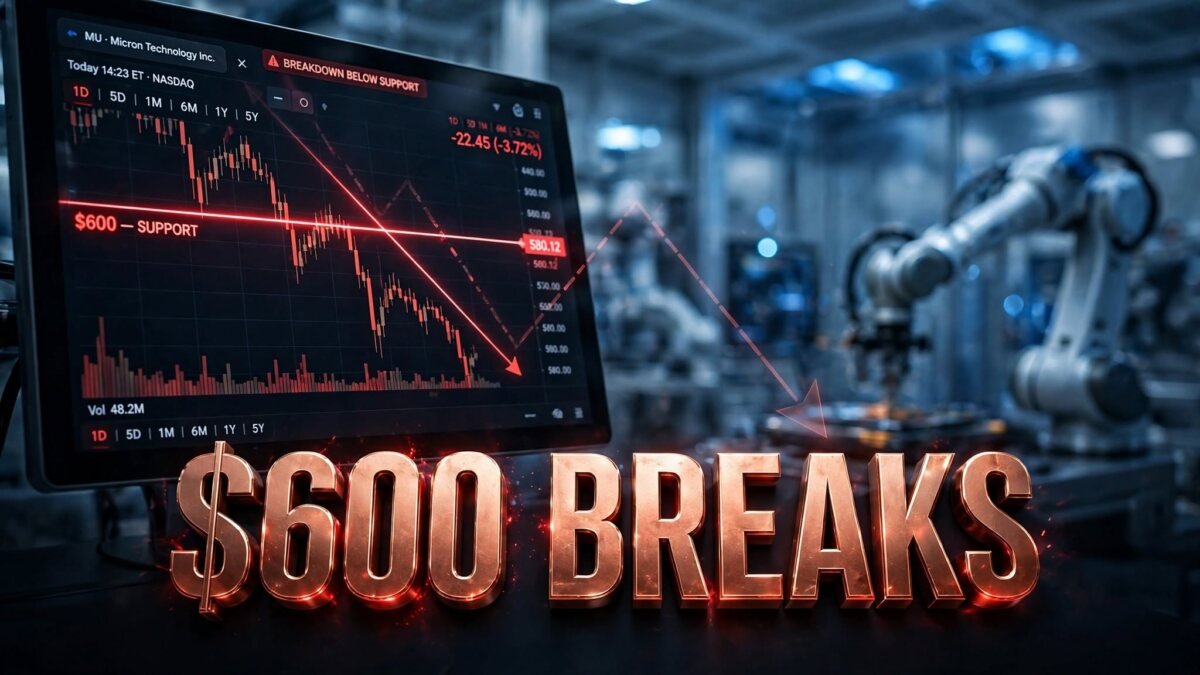
Micron stock $600 support shattered in premarket trading Wednesday, with shares of the memory chipmaker briefly touching $594 before recovering to around $603.67. The breach of the psychological round number marks a critical technical failure for a stock already reeling from a broader semiconductor selloff, peak-cycle anxiety in the memory sector, and the collapse of the Nvidia-led AI rally that briefly lifted Micron above $700 just two days earlier. If the breakdown holds on heavy volume, algorithmic stop-loss orders could accelerate a slide toward the $450-$500 consolidation range that served as support earlier this year—a potential 16% to 25% structural correction.
The Anatomy of the Micron Stock $600 Support Breakdown
The move did not happen in isolation. It was the culmination of a brutal sequence for Micron and its semiconductor peers.
On Monday, November 23, Micron surged over 10% alongside the entire AI complex after Nvidia’s board unexpectedly reinstated Jensen Huang as CEO. The stock briefly topped $700, recovering a portion of the losses incurred during the prior week’s rout. That rally lasted less than 48 hours.
By Wednesday, the semiconductor bid had evaporated. Nasdaq 100 futures fell 2.2% premarket after reports that the Trump administration could impose new tariffs on imports from 16 trading partners. Nvidia lost 4.9% before the open. AMD and Marvell each dropped more than 5%. Micron fell 5.9% in the same session. The AI trade, which had been the market’s leadership group all year, was now the source of its instability.
The $600 level mattered because it was more than a round number. It coincided with a dense concentration of options positioning that had formed a defensive line for the stock. When that line broke in premarket trading, the technical damage was immediate. A close below $600 on above-average volume would confirm the breakdown and likely trigger systematic selling from quantitative funds that key off support levels.
Why the Memory Cycle Is Suddenly a Liability
Micron’s fundamental problem is not demand. The company has reported that 75% of its 2027 capacity is already sold out under long-term agreements, and the AI-driven demand for high-bandwidth memory (HBM) remains structurally robust. The problem is what the market is willing to pay for that demand.
Peak-cycle anxieties in the memory sector are spreading from NAND to DRAM and high-bandwidth memory. Investors worry that even with strong AI server demand, as peers gradually bring new capacity online, overall memory price elasticity and room for gross margin expansion could moderate by 2027. The memory business has always been cyclical. The fear now is that the current upcycle is closer to its end than its beginning, and that Micron’s record margins are a peak rather than a plateau.
BNP Paribas added fuel to that fear with a downgrade earlier in the week, cutting its price target on Micron from $1,700 to $775 and citing risks to AI-driven memory demand and new wafer capacity. The stock fell 10% on that call, and it has not recovered.
The macro backdrop compounds the pressure. With October core PCE inflation accelerating to 3.3% and Fed funds futures pricing a 97% chance of a December rate hike, the discount rate applied to cyclical hardware earnings stays elevated. Higher-for-longer rates hit long-duration assets hardest, and Micron—despite trading at roughly 4 times forward earnings —is not immune to that math.
The Technical Picture: What Happens If $600 Fails
The Micron stock $600 support level was never a guarantee. It was a line in the sand that buyers had defended during the initial phase of the selloff. Now that it has been tested and breached, the downside map becomes clearer.
The $450-$500 range served as a consolidation platform in the first quarter of 2026. That is the next meaningful technical support zone. A move to that area would represent a 16% to 25% decline from current levels, depending on where the stock settles. The risk of that scenario materializing is elevated if selling pressure persists and the broader AI de-risking trend continues.
There is a counterargument. Micron’s valuation is historically cheap relative to its contracted 2027 cash flows. The disconnect between strong fundamentals and weak sentiment is stark. If core PCE data released later Wednesday does not exceed expectations and Treasury yields retreat, the stock could find enough breathing room to defend $600 and stabilize. But that is a conditional outcome, not a base case.
How Micron Fits the Broader AI Unwind
Micron is not the epicenter of the AI selloff. That distinction belongs to Nvidia, which has lost nearly half its value from its peak amid an SEC accounting probe and the governance chaos surrounding Jensen Huang’s resignation and reinstatement. But Micron is a high-beta proxy for the same set of concerns.
The AI infrastructure buildout requires memory. Every GPU cluster needs HBM. Every data center needs DRAM and NAND. If the market believes AI capital expenditures will slow—or that the profits from those expenditures will be less spectacular than previously assumed—Micron gets hit. The company’s revenue is tied directly to the spending plans of hyperscalers and server manufacturers.
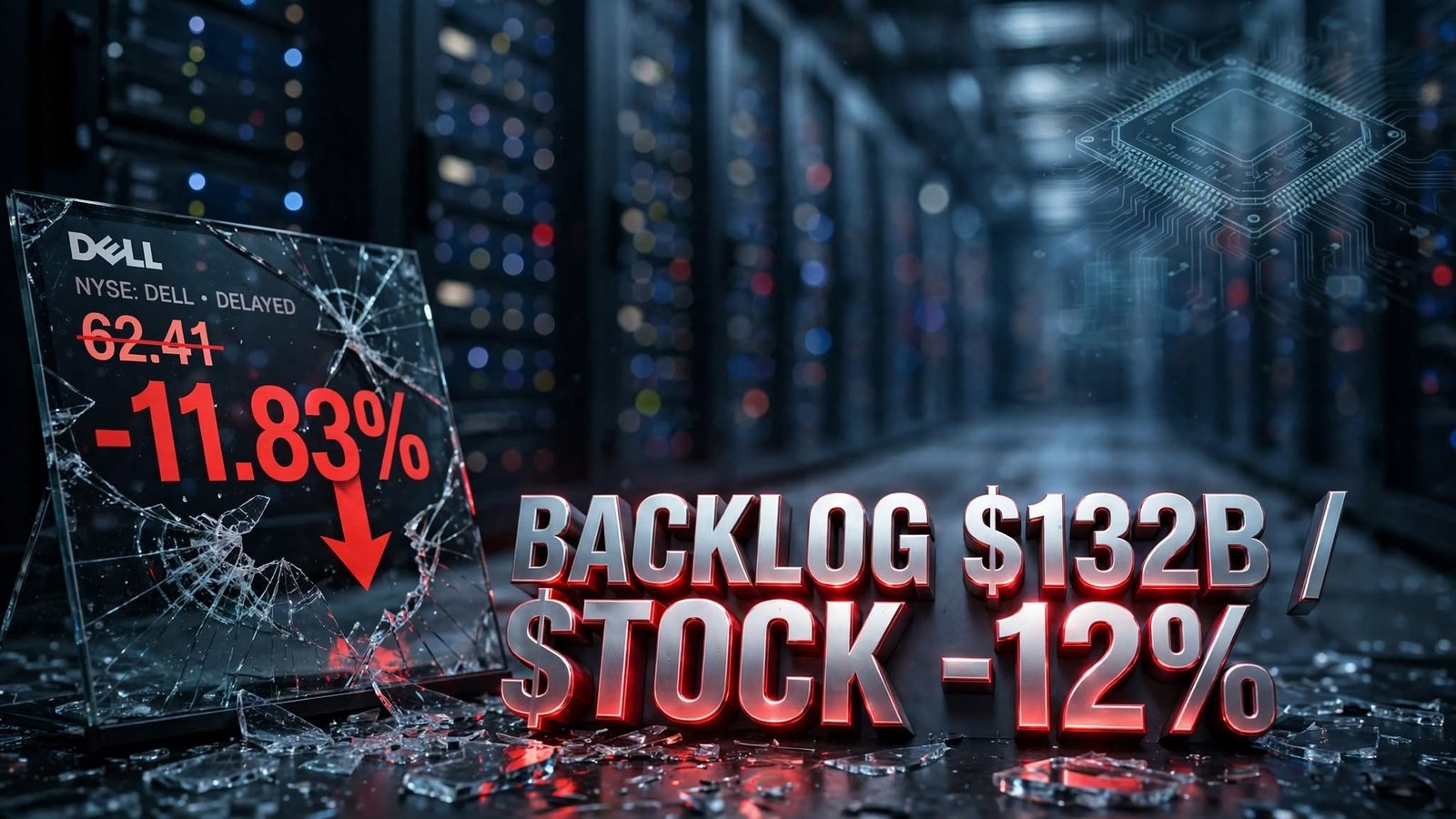
Dell’s earnings this week offered a partial rebuttal to the bear case. The company reported $132.3 billion in AI server backlog and raised its full-year revenue guidance, indicating that demand for AI infrastructure remains robust. But Dell’s stock fell anyway on margin concerns, and the memory cost pressure that Dell management cited—server DRAM and enterprise NAND pricing—is the same dynamic that benefits Micron on the revenue side while threatening its customers’ profitability. The ecosystem is interconnected, and right now the market is repricing every node in it.
BS Maurya Research Verdict
The Micron stock $600 support break is a technical event with fundamental implications. The company’s business remains solid. The AI memory demand story is intact. But the stock was priced for a world where the memory cycle never turns and AI spending grows indefinitely. That world is being repriced in real time.
For retail investors, the key question is not whether Micron is a good company. It is whether the risk-reward at current levels compensates for the volatility. A 4x forward P/E looks cheap until you remember that memory stocks have historically traded at single-digit multiples near cycle peaks for good reason. The market is not being irrational by applying a discount to cyclical earnings. It is being cautious, and caution is warranted when the macro backdrop is tightening and the AI trade is unwinding.
Watch the $600 level on a closing basis. If Micron reclaims it with conviction, the breakdown was a false alarm. If it closes below and stays there, the path toward $450-$500 becomes the base case. Position sizing should reflect that binary risk.
FAQ
1. What does the Micron stock $600 support level mean?
The $600 level was a psychological round number that coincided with heavy options positioning and served as a short-term floor during the initial AI selloff. Its breach signals that buyers are no longer defending that price, opening the door to further downside.
2. How low could Micron stock go if $600 fails?
Technical analysts point to the $450-$500 range as the next major support zone, representing a potential 16% to 25% decline from current levels.
3. Why is Micron falling when AI demand is still strong?
The market is pricing in peak-cycle concerns. Investors fear that memory margins will compress as new capacity comes online and AI capital expenditure growth moderates, even if current demand remains robust.
4. Did Dell’s earnings affect Micron stock?
Indirectly, yes. Dell’s warning about server DRAM and enterprise NAND cost pressures highlighted the margin squeeze that memory pricing is creating for hardware manufacturers. While that pricing benefits Micron’s revenue, it raises questions about the sustainability of the broader AI hardware ecosystem.
5. What should investors watch next for Micron?
The December 9 capital return update and the December 17 fiscal Q1 earnings report are the next major catalysts. Micron’s ability to hold $600 into those events will determine whether the current breakdown is a temporary technical breach or the start of a deeper correction.