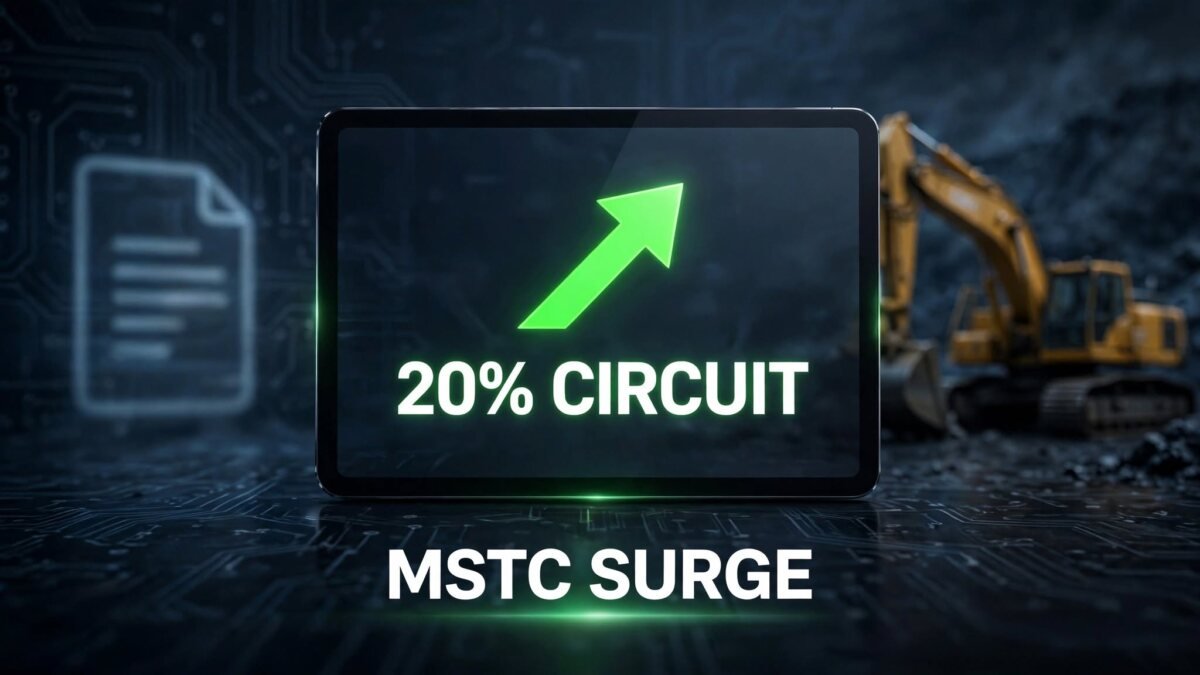
Some stocks move on hype. MSTC moved on hard numbers, a regulatory green light, and a parent company unlocking value. The market responded by locking it at the 20% upper circuit.
On November 13, 2026, shares of MSTC Ltd, a government-owned e-commerce and auction services provider, hit the 20% upper circuit limit at ₹783.65 on the BSE. The rally was driven by a powerful combination of strong Q2 earnings and a fresh regulatory approval from the Reserve Bank of India.
But the bigger story lies beneath the surface. MSTC is not just a PSU stock having a good day. It sits at the intersection of India’s digital procurement boom and a new business vertical that could change its growth trajectory.
The Q2 Reality: Margins That Rival Tech Companies
MSTC’s September quarter results were exceptional by any measure.
The company reported a 57.7% year-on-year jump in consolidated net profit to ₹74.92 crore, up from ₹47.50 crore in the same quarter last year. Revenue from operations grew 29.4% to ₹110.02 crore.
The real standout was the margin. EBITDA margin expanded to 67.15%, up from 60.62% a year earlier. For a PSU operating in the e-commerce space, this level of profitability is rare. It reflects the asset-light nature of MSTC’s business—it runs digital auction platforms for scrap, minerals, and government procurement without owning heavy infrastructure.
The company also disclosed that its e-commerce platforms processed transactions exceeding ₹54,580 crore in the first half of FY27. That is the scale MSTC operates at, even if its own revenue is a fraction of that number.
The TReDS Approval: A New Growth Engine
The second trigger was regulatory. The RBI granted MSTC in-principle approval to set up a Trade Receivables Discounting System (TReDS) platform, according to an exchange filing dated November 11, 2026.
For those unfamiliar, TReDS is a mechanism designed to solve a chronic problem for small businesses: delayed payments. When an MSME supplies goods to a large buyer, it often waits months to get paid. TReDS allows the MSME to upload its unpaid invoice onto a platform, where banks and financiers bid to buy it at a discount. The MSME gets cash immediately, and the financier collects from the buyer later.
For MSTC, this is a natural extension of its existing e-commerce and auction business. It already facilitates transactions between government entities and private players. Adding a financing layer creates a new revenue stream without requiring significant capital.
The approval is only “in-principle,” meaning MSTC still needs to meet RBI’s conditions before launching. The company has not announced a launch date.
The Mahanadi Coalfields Connection
There is a third factor that rarely gets mentioned but matters for the broader PSU sentiment: the upcoming Mahanadi Coalfields IPO.
Coal India is planning to launch the IPO of its subsidiary Mahanadi Coalfields next week, with an issue size of approximately ₹9,500 crore ($1 billion). The entire offering is an offer-for-sale, meaning Coal India will sell up to 66.18 crore shares (10% of its stake), and all proceeds will go to the parent.
MSTC and Coal India are both PSUs under the Ministry of Steel and Ministry of Coal respectively. When a major PSU event like the Mahanadi IPO is in the headlines, the entire PSU basket often sees heightened investor interest. MSTC, with its strong earnings and new business catalyst, became a natural beneficiary of that rotational flow.
The Risk: A Circuit Is Not a Business Model
A 20% upper circuit is exciting, but it is also a warning sign. It means the stock is moving faster than the market can absorb. When the circuit opens, volatility is likely.
The TReDS business, while promising, is not yet operational. MSTC has not announced a launch date. The revenue contribution from this segment is unknown. And the competition is real—other entities already operate TReDS platforms.
The core business remains government auctions and scrap trading, which is cyclical and dependent on government policy. The margins are high, but the revenue growth is modest.
BS Maurya Research Verdict
MSTC is a high-quality PSU with a unique asset-light business model, exceptional margins, and a new growth catalyst in TReDS. The Q2 numbers validate the fundamentals, and the RBI approval provides a forward-looking narrative.
But the stock is now expensive after the circuit. Investors who missed the move should not chase it at ₹783. Wait for the TReDS platform to become operational and for the next quarter’s earnings to confirm whether the growth is sustainable. For those who already hold it, the question is whether to book partial profits or hold for the long-term TReDS story.
FAQ
Q1: Why did MSTC share price hit the upper circuit?
MSTC shares hit a 20% upper circuit after reporting a 57.7% jump in Q2 net profit to ₹74.92 crore and receiving RBI’s in-principle approval to set up a TReDS platform for MSME financing.
Q2: What is TReDS and why does it matter for MSTC?
TReDS (Trade Receivables Discounting System) is a platform that helps MSMEs get early payment on unpaid invoices. For MSTC, it opens a new revenue stream in digital receivables financing without requiring heavy capital investment.
Q3: How does the Mahanadi Coalfields IPO affect MSTC?
Both are PSUs. The upcoming ₹9,500 crore Mahanadi Coalfields IPO (by Coal India) has generated renewed investor interest in the PSU space, benefiting stocks like MSTC with strong earnings momentum.
Q4: Is MSTC a good buy after the 20% circuit?
The fundamentals are strong, but the stock has run up sharply. Investors should wait for the TReDS platform to launch and for the next quarter’s results before entering at these levels.