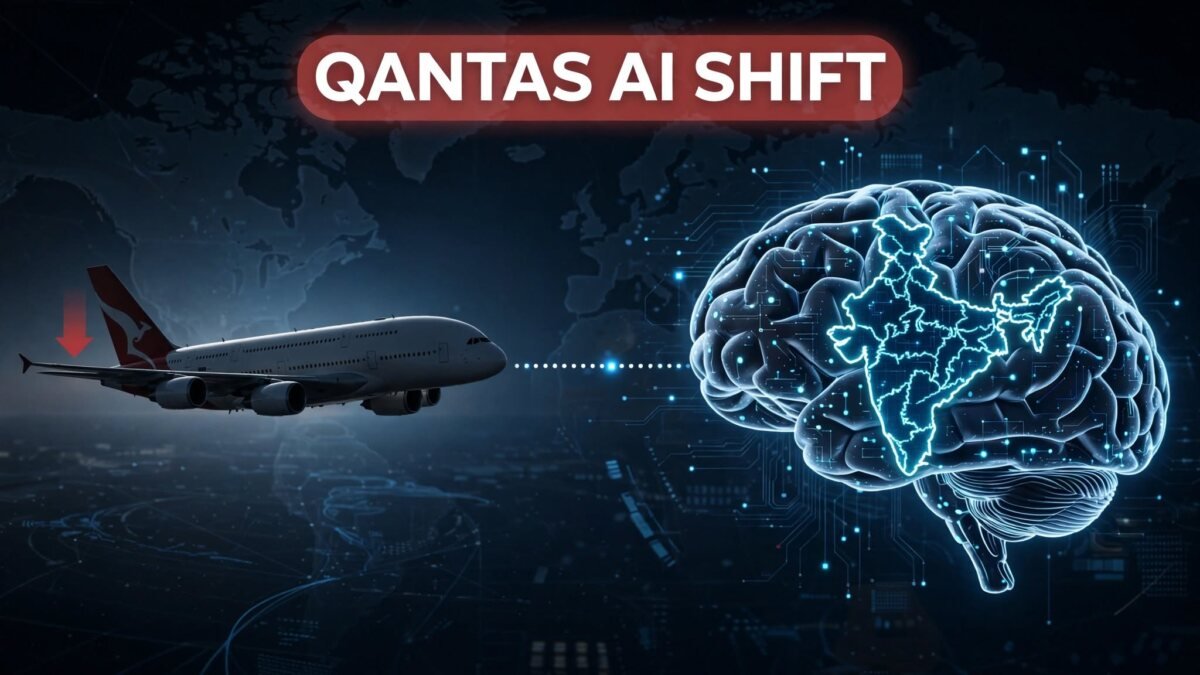
Qantas is not struggling to survive. It is restructuring to compete in an AI-driven future. And that future, increasingly, runs through India.
On November 10, 2026, Australia’s national airline confirmed it will cut approximately 850 jobs as part of a technology outsourcing agreement with Accenture. The roles affected are primarily in finance, procurement, and marketing, with some sources also indicating human resources. The work is not simply disappearing. It is being shifted to Accenture, with most of the services to be delivered from India, and the processes will be further transformed through automation and AI over time.
This is not a story about an airline in crisis. It is a story about how large corporations are using AI to fundamentally change their cost structures—and why India is at the center of that shift.
The Business Logic: Why Qantas Is Doing This
Qantas CEO Vanessa Hudson was direct about the rationale: “Leading organizations around the world are well progressed in using technology and AI to completely transform how they work. Standing still is not an option”.
The airline is not cutting these jobs because it is losing money. It is cutting them because the work can be done cheaper and faster elsewhere. By outsourcing to Accenture and gradually deploying AI tools, Qantas expects to modernize its back-office technology and become more efficient. Hudson noted that Qantas runs on more than 1,000 legacy applications that were never designed to work together, and the partnership will help the airline “unlock innovation faster and accelerate our use of AI”.
The affected employees were informed on Tuesday morning. Hudson acknowledged the uncertainty facing workers, saying she is “sorry for the uncertainty it brings” and that it “will be hard news for some”. The airline will now consult with affected workers and their unions, with the first wave of changes expected to be in place by mid-2027.
The India Connection: Why This Matters
The most significant detail in this story is where the work is going. Accenture will deliver most of its services for Qantas from India, though some roles will remain in Australia.
This is not a coincidence. India has become the global hub for technology outsourcing, and the AI revolution is accelerating that trend. Companies like Accenture are building large AI and automation teams in India to serve clients in the US, UK, and Australia. When a company like Qantas decides to modernize its back office, the work increasingly flows to Indian talent. Accenture has more than 84,000 staff in India, according to LinkedIn data cited by the Sydney Morning Herald.
For Indian readers, this is a double-edged sword. On one hand, it means more high-value jobs in AI, automation, and technology services are coming to India. On the other hand, it shows that even white-collar roles in developed markets are not immune to AI-driven restructuring.
The Bigger Pattern: AI Is Reshaping Corporate Cost Structures
Qantas is not alone. The airline industry has been progressively adopting AI for everything from pricing and route optimization to customer service and back-office operations. The pandemic accelerated digital transformation, and the current wave of AI tools is pushing it further.
The pattern is consistent across industries: companies are not just cutting jobs. They are re-engineering workflows around AI and outsourcing the remaining human-dependent tasks to lower-cost locations. Qantas joins other Australian companies like Woolworths, Coles, and National Australia Bank in shifting corporate roles offshore or investing heavily in India and Vietnam-based teams.
For investors, the signal is clear: companies that successfully integrate AI into their operations will have a structural cost advantage. Qantas is making a bet that this restructuring will pay off in the long run. Whether it does will depend on execution—and on whether the airline can maintain service quality while cutting costs.
What This Means for Workers and Investors
For workers in developed markets: The Qantas decision is a reminder that AI-related job displacement is not limited to factory floors or low-skill roles. Finance, procurement, and marketing are all vulnerable to automation and offshoring. The Australian Services Union criticized the move, claiming Qantas had previously assured staff there were no plans to offshore jobs under the Accenture deal—a claim Qantas denies.
For Indian professionals: The trend is more positive. Global companies are increasingly viewing India as a destination for AI and technology services, not just low-cost call centers. The work coming to India is higher-value and more specialized.
For investors: Qantas shares are not likely to move dramatically on this news alone. The restructuring is a long-term cost play. The real question is whether the airline can execute the transition without disrupting its operations or damaging its brand.
BS Maurya Research Verdict
Qantas is making a rational business decision. AI and outsourcing are powerful tools for reducing costs and improving efficiency. But the human cost is real, and the airline’s handling of the transition will matter for its reputation.
For Indian investors, this is another data point confirming India’s growing role in the global AI services economy. For Australian workers, it is a warning that the AI transition is not a distant threat. It is happening now.
FAQ
Q1: How many jobs is Qantas cutting?
Qantas is cutting approximately 850 jobs, representing about 3% of its 28,000-strong Australian workforce.
Q2: Why is Qantas cutting these jobs?
The airline has signed a multi-year technology outsourcing agreement with Accenture to modernize its back-office operations using AI and automation. The work will be delivered primarily from India, where Accenture has significant operations.
Q3: Is Qantas in financial trouble?
No. This is a restructuring for efficiency, not a rescue. CEO Vanessa Hudson framed it as a necessary step to stay competitive in an AI-driven business environment.
Q4: What does this mean for India?
It confirms India’s position as a global hub for AI and technology services. More high-value work is flowing to Indian teams as global companies restructure around AI.