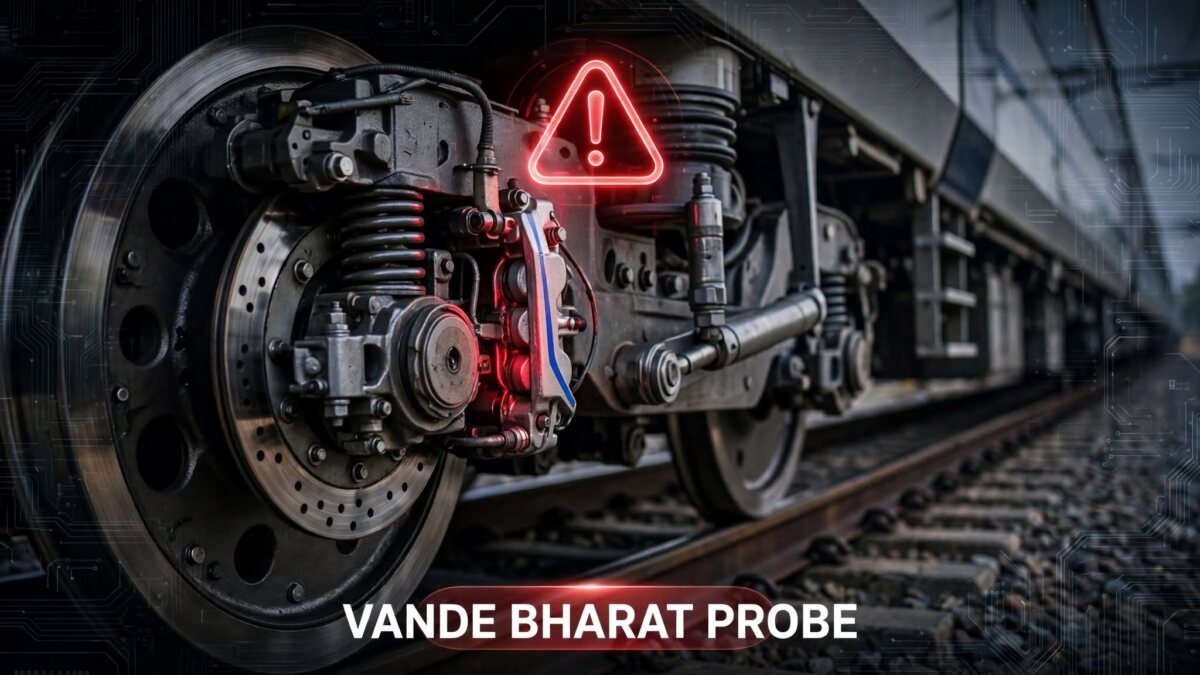
The Vande Bharat Express is the poster child of modernizing Indian Railways. But a specific incident in the Ranchi division has exposed a serious safety lapse that goes beyond routine maintenance concerns.
An empty Vande Bharat chair car rake was allowed to travel approximately 463 kilometers from Hatia in Jharkhand to Deen Dayal Upadhyaya (DDU) station in Uttar Pradesh on October 24, 2026, despite its coach brakes being completely non-functional. The South Eastern Railway zone has ordered a detailed probe into the incident, directing the Divisional Railway Manager of Ranchi to ascertain the lapses and take corrective measures.
This is not a story about “skipped safety checks” or “supply chain irregularities” in the abstract. It is a documented case of multiple staff failures that allowed a train with no effective braking system to be hauled hundreds of kilometers.
What Actually Happened
The sequence of events, according to the South Eastern Railway’s order dated November 7, 2026, is as follows:
The Plan: The empty Vande Bharat rake was to be moved by a freight locomotive from Hatia to Jhansi. The Vande Bharat’s braking system was supposed to be integrated with that of the goods locomotive for the entire journey.
The First Warning: After departure from Hatia, the loco pilot conducted a brake power test and found that the train’s brake power was “very poor and ineffective.” Upon arriving at Ranchi Junction, the loco pilot submitted a written complaint to the Section Controller and Traction Loco Controller.
The Second Warning: Another loco pilot who operated the train from Muri station also informed controllers about the poor braking performance, specifically reporting that the brakes could not be applied by “dropping the BP pressure”.
The Failure: Despite these warnings, the train was permitted to proceed in the same condition. It was only at DDU station that staff took the matter seriously. An inspection there found that the braking systems of all the coaches had been isolated, meaning the brakes could not be applied at all.
The train traveled the entire 463 km using only the locomotive’s brakes and regenerative braking, without any contribution from the coach braking systems.
Who Was Found Negligent?
The preliminary probe identified multiple failures:
Coach and wagon (C&W) staff failed to physically check whether the brakes were functioning properly before allowing the empty rake to depart.
Section and traction controllers at the concerned stations took no action despite receiving information about the poor brake power.
The train crew was unfamiliar with the Vande Bharat’s braking system and failed to physically check whether the brakes were being applied in the coaches.
The order concluded: “From the above, it is evident that there were multiple failures on the part of various staff, resulting in the train being worked without effective train brakes”.
Why This Matters Beyond the Ranchi Division
The timing of this incident is particularly troubling. It occurred on October 24—just over two weeks before the Kolkata-Sairang Express derailed in Assam on November 11, allegedly due to an almost similar issue with braking. The proximity of these two events has raised broader questions about safety protocols across Indian Railways.
The Vande Bharat Express is a semi-high-speed train designed to operate at speeds up to 160 km/h. Running such a train without adequate brake power is, as the South Eastern Railway itself stated, “a serious safety concern that may lead to a major accident, endangering the lives of staff and passengers”.
This is also not an isolated maintenance issue for the Ranchi division. In June 2026, the Varanasi-Ranchi Vande Bharat Express was stranded for over four and a half hours in Bihar after a brake system malfunction, with passengers running out of water and receiving little information. The Hatia yard, which maintains Ranchi’s Vande Bharat trains, was approved for two new pit lines in April 2026 to improve local maintenance capacity, but the work is expected to take 1.5–2 years to complete.
The Corporate Governance Angle
The draft’s framing of this as a “corporate governance” issue is valid, but the specific failure is more basic than “lack of rigorous audits” or “cutting corners on targets.”
The core governance failure here is accountability in the chain of command. Multiple staff members at different levels—C&W, controllers, and crew—had information about a critical safety defect and failed to act on it. The system allowed a train with isolated brakes to proceed through multiple stations and checks without being stopped.
For investors in railway PSUs and infrastructure companies, this incident reinforces a point that is often overlooked: operational execution is not just about winning contracts or meeting deadlines. It is about the mundane, unglamorous discipline of following safety protocols when no one is watching. Companies that cannot demonstrate this discipline carry hidden operational risks that may not show up in financial statements until a crisis hits.
What Should Investors Watch?
1. Railway PSUs: Companies like RVNL, IRCON, and Titagarh Rail Systems operate in the railway ecosystem. This specific probe is unlikely to directly impact their financials, but a broader regulatory crackdown on safety standards could affect project execution timelines.
2. Safety and Monitoring Systems: If Indian Railways mandates stricter brake monitoring or alert systems for Vande Bharat trains post-probe, companies providing sensors and monitoring hardware could see increased demand.
3. The Maintenance Ecosystem: The Hatia yard’s capacity constraints—only eight pit lines for approximately 24 trains, with two more approved but years away—highlight the infrastructure gaps in India’s premium train maintenance network. Companies involved in railway maintenance infrastructure could benefit from increased investment.
BS Maurya Research Verdict
The Ranchi Vande Bharat probe is not about abstract “maintenance failures.” It is about a documented incident where multiple railway employees ignored repeated warnings about a critical safety defect, allowing a train with no functioning coach brakes to travel 463 km.
The South Eastern Railway’s decision to order a detailed probe is the right response. But the fact that this happened at all—and that it echoed a similar braking failure in the Kolkata-Sairang derailment weeks later—suggests that the problem is systemic, not isolated.
For investors, this is a reminder that the India infrastructure growth story has operational risks that do not appear in order books or revenue guidance. The companies that prioritize safety and accountability will be the ones that compound wealth sustainably over the next decade. Those that treat safety as a compliance checkbox will eventually face the consequences.
FAQ
Q1: What exactly triggered the Ranchi Vande Bharat probe?
An empty Vande Bharat rake was allowed to travel 463 km from Hatia to DDU station on October 24, 2026, despite its coach brakes being completely isolated and non-functional. Two loco pilots reported the poor brake power, but the train was permitted to proceed anyway. The South Eastern Railway ordered a probe into the lapses.
Q2: Were passengers on board during the incident?
No. The rake was empty and was being hauled by a freight locomotive from Hatia to Jhansi for maintenance or repositioning.
Q3: Is it safe to travel on Vande Bharat Express trains now?
The probe is a proactive measure to identify and correct safety lapses. The trains remain in operation, and the investigation is focused on accountability and preventive measures. However, the incident and the subsequent Kolkata-Sairang derailment have raised legitimate questions about braking system protocols that authorities are now addressing.
Q4: Which companies are affected by this probe?
The probe is focused on railway staff accountability, not on specific companies. Railway PSUs like RVNL and IRCON are part of the broader ecosystem but are unlikely to face direct financial impact unless the investigation reveals systemic issues that slow project approvals.
Q5: What does this mean for Indian Railways’ modernization plans?
It reinforces the need for stricter oversight and better training, particularly for new-generation trains like Vande Bharat that have different braking systems from conventional rakes. It may cause short-term delays in scheduling or maintenance processes, but the long-term effect should be stronger operational robustness.


