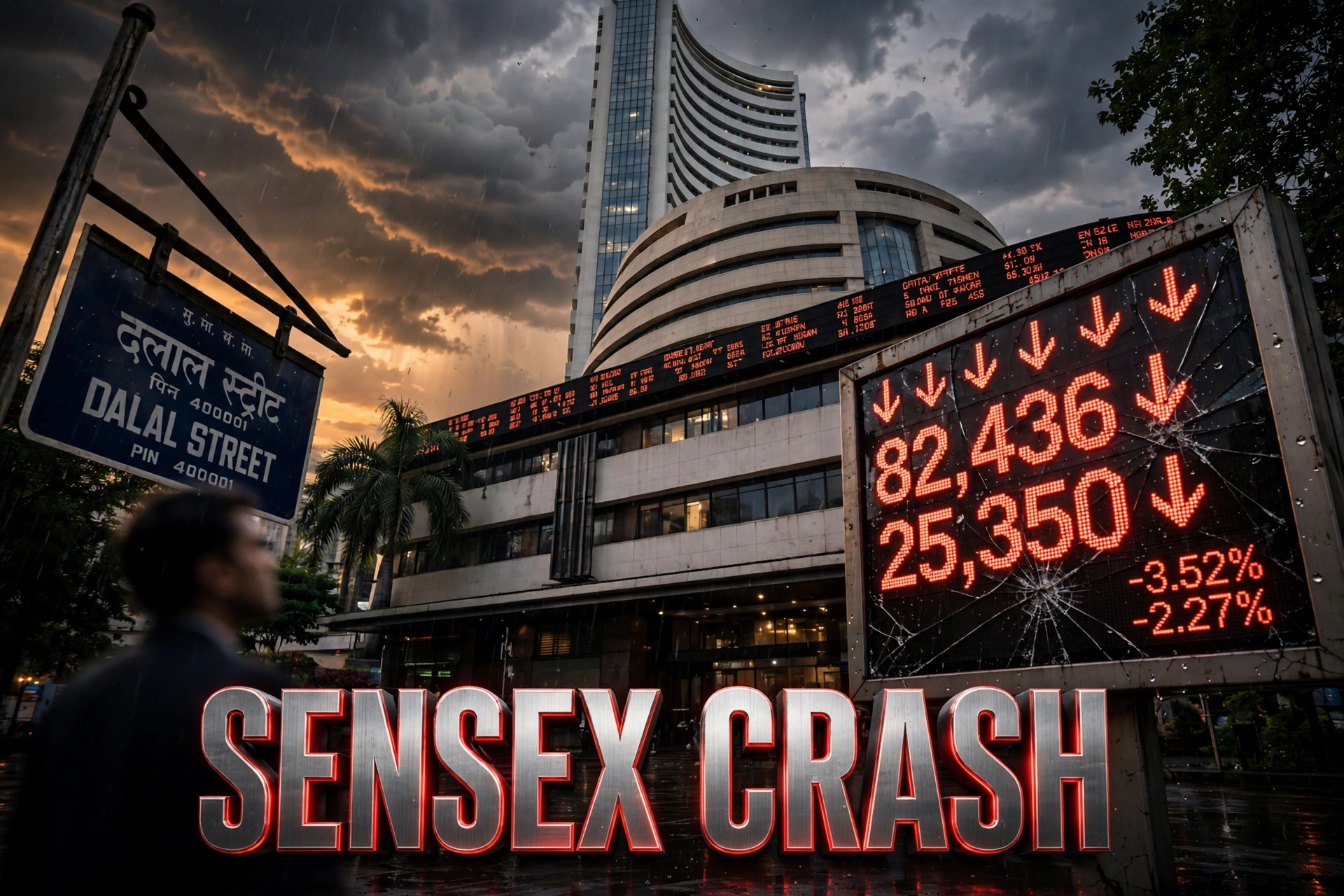
The Sensex Nifty stock market crash on Monday erased over ₹5 lakh crore of investor wealth in a single session, with the Sensex plunging 1,484 points to 82,436 and the Nifty 50 dropping 451 points to 25,350. It was the sharpest single-day decline in nearly five months, and it came without warning after a four-week rally that had made India one of Asia’s best-performing markets.
The selloff was not a domestic story. It was a global risk-off wave that hit Indian shores through the banking and metals sectors, compounded by local profit-booking after the Nifty had rallied nearly 15% over the preceding month. For retail investors who piled into the rally, the question now is whether this is a buying opportunity or the start of something deeper.
What Actually Triggered the Sensex Nifty Stock Market Crash?
Three forces converged on Dalal Street on Monday. The first was a global AI-led selloff that originated on Wall Street. The Nasdaq Composite had crashed 5.3% on Friday night, and the S&P 500 fell 3.7%, as investors questioned whether the artificial intelligence investment boom had peaked. When Asian markets opened on Monday, major indices in Japan and South Korea posted steep losses. India was not immune.
The second force was domestic profit-booking. Foreign institutional investors had pumped nearly ₹1.4 lakh crore into Indian equities in November, driving the Nifty within 199 points of the 26,000 mark. Local traders used the global weakness as an excuse to lock in gains. Domestic funds turned net sellers, offloading ₹2,760 crore worth of shares.
The third was a sector-specific shock in metals. Tata Steel crashed 8.4% after announcing its acquisition of a 26.6% promoter stake in APL Apollo Tubes for ₹15,510 crore, with plans for an additional 26% through an open offer. APL Apollo plunged 21%, its steepest single-day decline since March 2020. The Nifty Metal index fell over 3%, leading sectoral losses.
Banks Bore the Brunt of the Selling Pressure
The banking sector was the single biggest drag on the indices. The Nifty Bank index crashed over 2,000 points, or 4%, to 62,585, with Axis Bank, HDFC Bank, ICICI Bank, and State Bank of India each falling up to 4%. Financial heavyweights alone accounted for a disproportionate share of the Sensex’s decline.
Vinod Nair of Geojit Investments attributed the fall to “concerns over elevated AI valuations, the sustainability of AI-led capital expenditure, and the unwinding of crowded technology positions” spilling into domestic equities. In simple terms: when global funds de-risk, they sell the most liquid emerging market holdings first. Indian banks, as the heaviest weights in the index, become the exit door.
The Data Behind the Damage
| Metric | Monday’s Close | Change | Context |
|---|---|---|---|
| BSE Sensex | 82,436 | -1,484 points (-1.77%) | Biggest fall in nearly 5 months |
| NSE Nifty 50 | 25,350 | -451 points (-1.75%) | Steepest drop in 5 months |
| Nifty Bank | 62,585 | -2,050 points (-4%+) | Worst-performing sector |
| Nifty Metal | — | -3% to -3.6% | Tata Steel -8.4%, APL Apollo -21% |
| Market Cap Wiped | Over ₹5 lakh crore | — | BSE-listed companies |
| FII Flow (Nov) | +₹1.4 lakh crore | Net buyers | Despite Monday’s fall; 2026 YTD still net negative |
Source: CNBC TV18, Times of India, HDFC Sky
Is the Nifty’s Rally Dead, or Just Pausing?
Technical analysts are cautious. Nagaraj Shetti of HDFC Securities noted that Monday’s action “signals the formation of a short-term reversal pattern on the downside,” though the pattern requires confirmation in the next trading session. The Nifty fell over 640 points from the day’s high, forming a long bearish candle that indicates the possibility of further correction.
But the structural story is more nuanced. The Nifty had gained over 11% during the November series, its biggest advance since April 2020 and its best November performance since 2009. Foreign inflows of over ₹1.4 lakh crore had powered the rally, driven partly by a selloff in global AI-heavy indices that pushed capital toward emerging markets like India. If that AI selloff reverses and US tech stocks recover, some of that capital could flow back out.
What Retail Investors Should Watch
The immediate trigger to monitor is US technology earnings and Federal Reserve commentary. A sustained recovery in Nasdaq would reduce the safe-haven appeal of Indian equities. Conversely, if AI-related selling deepens, India’s relative stability could attract more foreign flows.
Domestically, the Tata Steel-APL Apollo integration is a test case for M&A execution risk. Ambareesh Baliga, an independent market expert, noted that APL Apollo could become attractive again after a 15-18% correction, but the management’s ability to handle a company nearly 50% larger than its current operations “is left to be proven”.
For long-term investors, the correction has reset valuations marginally. The Nifty now sits 3.9% below its all-time high of 26,373, compared with just over 2% before Monday’s fall. That is not a bargain-hunting trigger by itself, but it is a reminder that the index had run ahead of fundamentals.
BS Maurya Research Verdict
This is a profit-booking correction, not a structural bear market — yet. The drivers of Monday’s Sensex Nifty stock market crash were external (AI selloff, global risk-off) and technical (overbought rally, expiry-related volatility), not a deterioration in India’s domestic earnings cycle. Foreign investors remain net buyers for November, though Notably, 2026 year-to-date FII flows remain deeply negative at roughly ₹3.6 lakh crore in net selling. The banking sector’s fundamentals have not changed overnight.
However, retail investors should resist the urge to “buy the dip” indiscriminately. The Nifty’s next support level sits near 25,000, and a break below that would signal deeper weakness. For systematic investors, SIPs into broad-market index funds remain the disciplined approach. For direct equity holders, the focus should shift to earnings visibility over the next two quarters rather than trying to catch a falling knife.
The market’s biggest risk is not Monday’s fall. It is the possibility that the global AI trade unwinds further, pulling foreign capital out of India as quickly as it arrived.
Frequently Asked Questions
1. Why did the Sensex crash 1,484 points on November 23, 2026?
The crash was driven by a global AI-led selloff that hit Asian markets, domestic profit-booking after a roughly 15% rally, and a sharp fall in banking and metal stocks. Tata Steel’s acquisition announcement triggered a 21% collapse in APL Apollo, adding to the negative sentiment.
2. Which sectors were hit hardest in the Sensex Nifty stock market crash?
Banking and metals led the decline. The Nifty Bank fell over 4%, while the Nifty Metal index dropped over 3%. IT stocks were the exception, with TCS emerging as the biggest Nifty gainer as investors rotated out of AI-exposed global names.
3. Is this the start of a bigger market crash in India?
Most analysts view this as a profit-booking correction rather than a structural downturn. The Nifty remains 3.9% below its all-time high, and foreign inflows for November remain strongly positive. However, 2026 year-to-date FII flows are still net negative by roughly ₹3.6 lakh crore. The key risk is a sustained US tech recovery that pulls capital away from India.
4. Should I sell my mutual fund SIPs now?
No. SIPs are designed to average out volatility. Stopping SIPs during a correction locks in losses and removes the benefit of buying units at lower NAVs. If your financial goals are unchanged, continuing SIPs is the disciplined choice.
5. What is the next support level for the Nifty 50?
Technical analysts identify the 25,000 level as the next meaningful psychological support. A sustained break below that level would signal deeper weakness, while a bounce from current levels would suggest the correction has run its course.