Two of the largest money managers in America have just delivered the same uncomfortable number to retirees, and it is not a projection you can afford to ignore.
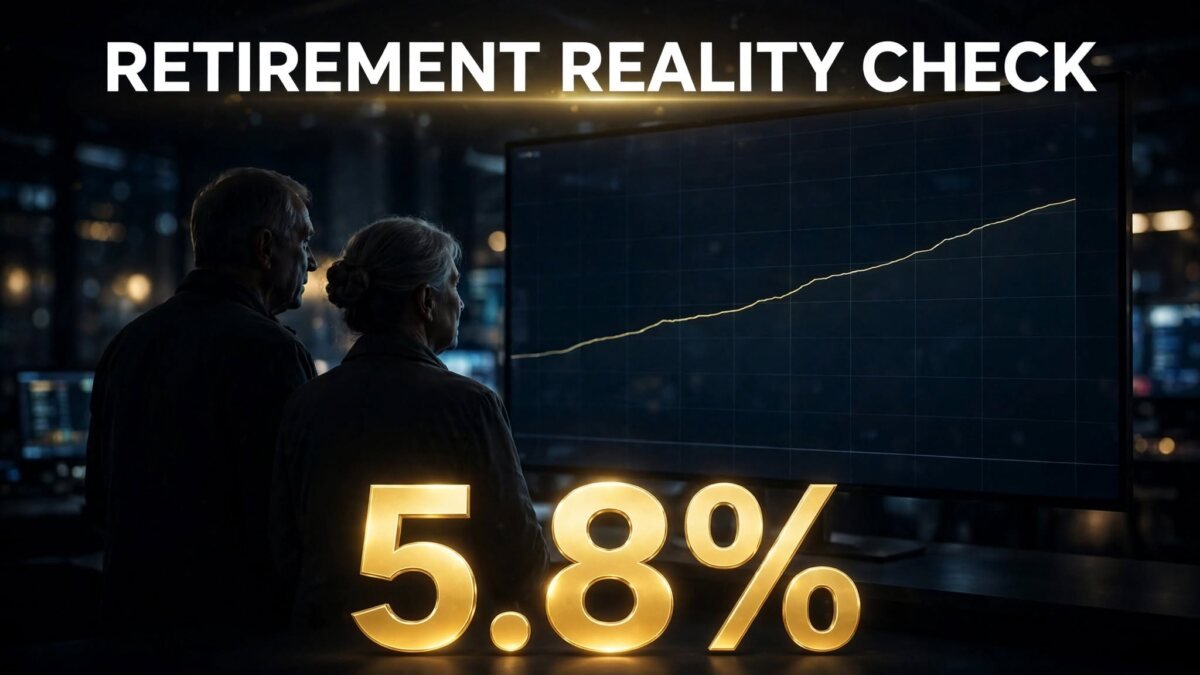
Vanguard’s latest 10-year outlook projects U.S. stocks will deliver an average annual return of just 4.8% to 6.8% over the next decade. Fidelity, looking further out with a 20-year horizon, expects 5.8% annualized returns for U.S. equities—or roughly 3.2% after inflation.
For context, the S&P 500 has returned roughly 10% annually over its long-term history. Over the past decade alone, it returned a staggering 15.2% per year. The new forecasts suggest investors should prepare for less than half of that recent performance.
Key Takeaways
The Forecast: Vanguard projects 4.8%–6.8% for U.S. stocks over 10 years. Fidelity projects 5.8% over 20 years. Both cite elevated starting valuations as the primary driver.
The Real Threat: For retirees, the danger is not the average return—it is sequence-of-returns risk. A market decline in the early years of retirement permanently reduces the capital available to recover.
The Bond Shift: Vanguard’s VCMM data shows U.S. aggregate bonds with a median 10-year expected return of approximately 4.8% (range 3.4%–6.3%), making bonds a more competitive alternative to equities than in the low-rate era.
The Math: A $2 million portfolio growing at 10% would reach roughly $4 million in a decade. At 5.8%, it reaches about $2.57 million. That is a difference of over $1.4 million.
Why the Forecast Is Lower (And Why It Makes Sense)
The logic is not complicated. When you pay a high price for a dollar of earnings today, the return you can expect over the next decade is lower. It is simple arithmetic.
Vanguard’s own model notes that U.S. equities “remain highly valued” and that the strongest risk-return profiles over the coming 5–10 years are, in order: high-quality U.S. fixed income, U.S. value-oriented equities, and non-U.S. developed-market equities. The exceptional bull market of the past decade pulled future returns forward, leaving less potential appreciation for investors buying at today’s prices. Fidelity’s research team reaches the same conclusion from a different model: lower growth potential and higher starting valuations mean returns will be below the long-term average.
This is not a prediction of a crash. It is a prediction of normalization. The past decade was exceptional. The next decade is likely to be more ordinary.
The Retiree Problem: Sequence-of-Returns Risk
For a 30-year-old with decades of compounding ahead, a 5.8% return is manageable. For a 66-year-old drawing income from their portfolio, it is a different equation entirely.
The critical issue is the order in which returns arrive. If you are withdrawing money and the market drops in your early retirement years, you are forced to sell assets at low prices. That permanently reduces the capital available to participate in any subsequent recovery.
Consider a 66-year-old couple with $2 million drawing $62,000 a year. If stocks return 10% annually, the portfolio reaches roughly $4.1 million by age 76. At 5.8%, it reaches approximately $2.57 million. That is a gap of over $1.4 million.
The difference is not abstract. It is the difference between a comfortable retirement and a constrained one.
The Silver Lining: Bonds Are Competitive Again
There is one genuinely positive development buried in these forecasts. Vanguard’s VCMM data shows U.S. aggregate bonds with a median 10-year expected return of approximately 4.8%, with a range of 3.4% to 6.3%.
This is a significant shift. During the era of near-zero interest rates, investors had little choice but to pile into stocks to generate meaningful returns. Now, bonds offer comparable expected returns with lower volatility. The trade-off between preserving capital and pursuing growth is less punishing than it was in the previous decade.
For retirees, this means a more balanced portfolio may be more appropriate than the aggressive equity allocations that worked so well in the past. Vanguard’s 2026 outlook specifically recommended a 40% stock / 60% bond allocation for investors with a medium-term horizon, citing the strongest risk-return profiles in high-quality fixed income. Importantly, Vanguard framed this as a concept for investors who cannot afford a major drawdown at the wrong moment—not as a universal mandate for every retiree.
What Retirees Should Do Now
Revisit your withdrawal rate. If you are planning to withdraw 4% or more annually based on assumptions of 10% returns, stress-test that plan against a 5.8% environment. A lower withdrawal rate, even 3.5%, provides significantly more margin for error.
Build a cash buffer. Financial planners recommend keeping one to two years of living expenses in cash or short-term bonds. If the market drops, you do not panic-sell your stocks. You use the buffer to pay bills while waiting for recovery.
Do not abandon equities. Stocks are still the best tool for beating inflation over the long term. The forecast is lower, not negative. A balanced portfolio with global diversification remains the most reliable path.
Expect volatility, not a straight line. These are 10-year and 20-year projections. The path between now and then will include sharp rallies and painful drawdowns. The forecast is a planning input, not a destiny.
BS Maurya Research Verdict
Vanguard and Fidelity are not predicting a crash. They are predicting a return to normal. The past decade was a statistical outlier. The next decade is likely to look more like the historical average.
For retirees, the lesson is not to abandon the stock market. It is to plan for a lower-return environment, keep a larger cash buffer, and use bonds as a genuine source of stability rather than an afterthought. The goal is not to maximize returns. It is to ensure your money outlasts you.
FAQ
Q1: What is the Vanguard and Fidelity stock market forecast?
Vanguard projects U.S. stocks will return 4.8% to 6.8% annually over the next decade. Fidelity forecasts 5.8% annualized returns over 20 years, or roughly 3.2% after inflation.
Q2: Why are the forecasts so low?
Elevated starting valuations are the primary reason. When stocks are expensive relative to earnings, future returns tend to be lower. The exceptional returns of the past decade pulled future gains forward.
Q3: What is sequence-of-returns risk?
It is the risk that a retiree experiences a market downturn early in retirement, forcing them to sell assets at low prices to fund living expenses. This permanently reduces the portfolio’s ability to recover.
Q4: How do bond returns compare?
Vanguard’s VCMM data shows U.S. aggregate bonds with a median 10-year expected return of approximately 4.8% (range 3.4%–6.3%), making bonds a more competitive alternative to equities than in the low-rate era.
Q5: Should retirees still invest in stocks?
Yes. Stocks remain the best tool for beating inflation over the long term. The forecast is lower, not negative. The key is to adjust withdrawal rates and maintain a cash buffer to avoid selling during downturns.