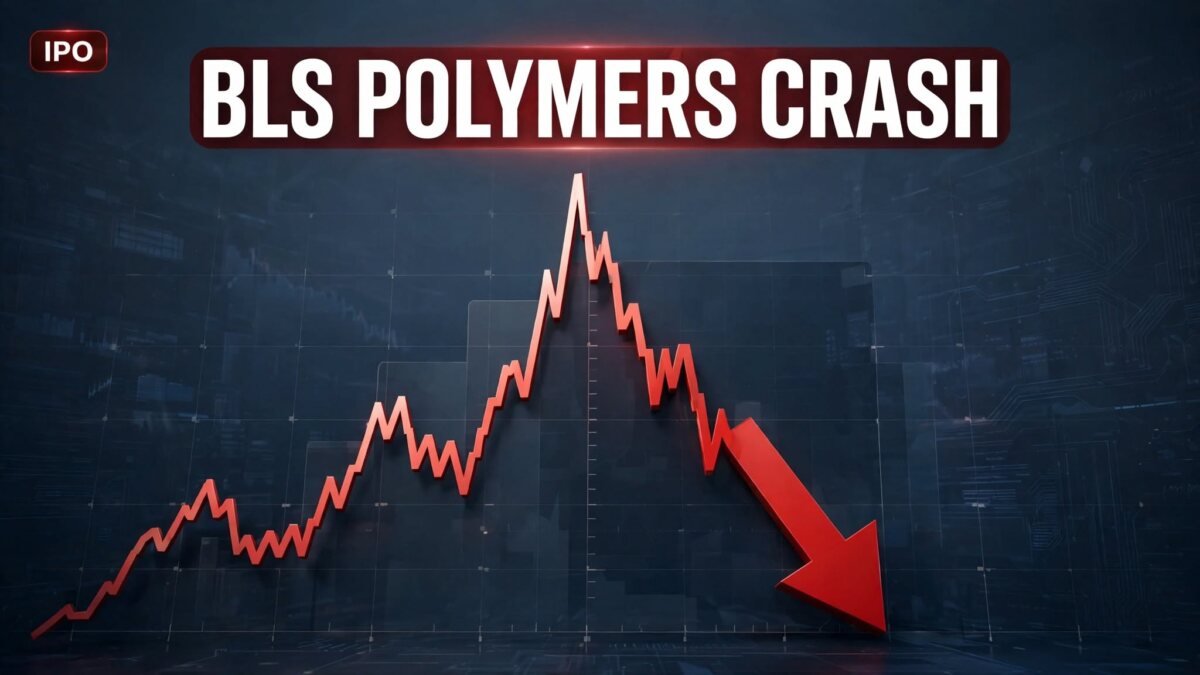
The BLS Polymers IPO opened with a 65% premium. Within days, the stock had fallen nearly 18% from its post-listing peak.
BLS Polymers’ ₹255-crore public issue attracted extraordinary investor demand before its stock market debut. The IPO was subscribed 241.22 times overall, while the non-institutional investor (NII) category was subscribed 559.20 times.
On November 3, 2026, the shares opened at ₹248 on the NSE, compared with the issue price of ₹150. That represented an opening premium of approximately 65.3%.
The stock subsequently closed its first trading session at ₹268.80, giving IPO investors a closing gain of 79.2%.
But the rally did not last.
The share price touched an intraday high of ₹288 on November 4 before falling to ₹235.79 by the November 6 market close.
That is a decline of approximately 18.1% from the ₹288 peak.
However, there is an important distinction: investors who received shares through IPO allotment and held them until November 6 were still sitting on a gain of around 57.2% over the ₹150 issue price. The losses were concentrated among investors who bought at higher post-listing prices.
So what changed after such a strong debut?
1. The Listing Was Strong, But the Rally Quickly Reversed
Here is how BLS Polymers performed during its first four trading sessions:
| Date | NSE price | Performance |
|---|---|---|
| November 3 | Open ₹248; close ₹268.80 | Opened 65.3% above issue price |
| November 4 | High ₹288; close ₹255.94 | Fell from the intraday peak |
| November 5 | Close ₹250.20 | Continued downward |
| November 6 | Close ₹235.79 | Fell another 5.76% |
The stock’s November 3 closing price was 79.2% above the IPO issue price. Its November 4 high of ₹288 became the short-term peak.
By November 6, the share price had fallen approximately 18.1% from that high.
The sequence highlights a familiar risk in newly listed stocks: a strong opening does not guarantee that the market will continue to support the same valuation.
Investors who purchased shares near the high were exposed to a much different risk than those who received IPO allotment at ₹150.
2. Subscription Was Extraordinary, But Demand Does Not Guarantee Value
The BLS Polymers IPO received 241.22 times subscription.
The category-wise figures were:
- Qualified Institutional Buyers (QIB): 200.25 times
- Non-Institutional Investors (NII): 559.20 times
- Retail Individual Investors: 128.36 times
The NII category generated particularly strong demand.
However, subscription figures measure how many times the available shares were bid for. They do not establish what a company’s shares are worth.
A highly subscribed IPO can still list at a valuation that investors later reconsider. Subscription data also does not tell us whether investors intend to hold shares for years or sell shortly after listing.
It would therefore be misleading to conclude that the NII demand was necessarily speculative or leveraged. The figures show strong bidding, not the motivations of every investor.
3. Was the IPO Valuation Aggressive?
BLS Polymers fixed its IPO price at ₹150 per share.
Its FY26 financial performance included:
- Total income: ₹354.41 crore
- Revenue from operations: Approximately ₹349.43 crore
- Profit after tax: ₹27.01 crore
- EBITDA: ₹46.60 crore
At the upper issue price, the company’s post-issue market capitalisation was approximately ₹930.48 crore.
Using FY26 profit and the post-issue share count, the implied price-to-earnings multiple was approximately 34.5 times FY26 earnings.
That is a valuation investors should examine carefully, particularly because the company is planning a significant expansion that will take time to become operational.
A valuation multiple by itself does not prove that a stock is overpriced. Investors must also consider growth, margins, return on capital, competitive position and future earnings potential.
But paying a higher multiple means the company must deliver sufficient earnings growth to support that valuation.
4. What Does BLS Polymers Actually Do?
BLS Polymers manufactures specialised polymer compounds used in several infrastructure-related industries.
Its products are used in:
- Electrical wires and cables.
- Power and telecommunications infrastructure.
- Railway applications.
- Underground oil, gas and water pipelines.
- Protective coatings, insulation and cable sheathing.
The company operates a manufacturing facility in Goa and supplies products to customers in India and overseas markets.
It is not a newly created business. The company was incorporated in 1991 and has been operating in the polymer industry for decades.
Its business is connected to infrastructure demand, which can provide long-term growth opportunities.
However, its manufacturing operations are concentrated at a single facility. That creates operational concentration risk: disruptions at the plant could affect production and deliveries.
Customer concentration, supplier dependence and working-capital requirements are also important factors to monitor.
5. The Financial Performance: Profit Is Growing, But Revenue Growth Has Slowed
The company’s financial results show improvement in profitability, although revenue growth has moderated.
| Financial year | Total income | Profit after tax |
|---|---|---|
| FY24 | ₹301.50 crore | ₹7.52 crore |
| FY25 | ₹336.70 crore | ₹21.14 crore |
| FY26 | ₹354.41 crore | ₹27.01 crore |
Revenue increased approximately 10.8% in FY25, followed by growth of around 5.3% in FY26 based on total income. Revenue from operations increased approximately 6.4% in FY26.
Profit after tax increased by around 27.8% in FY26.
The company also improved its EBITDA margin from approximately 7.1% in FY24 to 12.1% in FY25 and 13.3% in FY26.
This margin improvement is positive, but investors should ask whether the company can maintain it as production expands and competition changes.
The figures do not support the claim that revenue has remained flat for three years. A more accurate concern is that revenue growth slowed in FY26 even as profitability continued to improve.
6. Capacity Utilisation: The Expansion Question
One of the most important parts of the IPO story is the company’s planned manufacturing expansion.
According to the IPO disclosures, BLS Polymers had total installed manufacturing capacity of approximately 35,251 tonnes per year in FY26.
Its actual production was around 23,265 tonnes, equivalent to total capacity utilisation of approximately 66%.
The utilisation figures differed across product categories:
- Polyethylene compounds: approximately 75.3%.
- XLPE compounds: approximately 73.2%.
- PVC compounds: approximately 11.8%.
This distinction matters. Saying the entire manufacturing facility was operating at 75% capacity would be inaccurate.
The company plans to add approximately 52,050 tonnes of annual capacity through its expansion programme, taking planned capacity to around 87,301 tonnes.
The expansion could create room for future revenue growth, but the company will need sufficient customer demand, raw materials, working capital and operational efficiency to use that capacity profitably.
7. Where Will the IPO Money Go?
The ₹255-crore issue was a fresh issue of shares. Its stated objectives included:
- ₹77.56 crore: Expansion of the existing Goa manufacturing facility.
- ₹89.50 crore: Working-capital requirements.
- Remaining proceeds: General corporate purposes and issue-related requirements, as set out in the offer documents.
The expansion is expected to increase production capacity for selected polymer products.
However, the new facility capacity is not expected to become commercially operational immediately. The company’s stated target for commercial production is March 2028.
That creates an important gap between the money being invested today and the additional revenue the company hopes to generate later.
Investors should monitor construction progress, machinery installation, commissioning, customer orders and actual utilisation after the expansion.
A larger factory does not automatically translate into higher profits. It must generate enough sales and operating cash flow to justify the investment.
8. What Should Investors Watch After the Price Fall?
The fall from ₹288 to ₹235.79 has made the stock more affordable than it was at its peak. But a lower share price does not automatically mean a stock has become undervalued.
Investors should monitor the following developments:
Quarterly revenue growth: Does the company maintain or improve its sales growth after the IPO?
Profit margins: Can the company protect its EBITDA margin as production and operating costs increase?
Capacity expansion: Is the company progressing towards its March 2028 commercial production target?
Working capital: Can the company manage inventory, receivables and cash requirements without putting pressure on its balance sheet?
Valuation: Does the share price become more reasonable relative to future earnings and comparable listed businesses?
Trading volatility: Does the stock stabilise after the initial post-listing price swings?
These factors will provide more useful information than simply looking at the IPO subscription figure or the grey market premium.
What Does the Price Fall Mean for Different Investors?
The experience of BLS Polymers investors depends heavily on their purchase price.
| Investor’s purchase price | Position at ₹235.79 |
|---|---|
| IPO issue price ₹150 | Approximately 57.2% gain |
| Listing opening price ₹248 | Approximately 4.9% loss |
| Listing closing price ₹268.80 | Approximately 12.3% loss |
| Intraday peak ₹288 | Approximately 18.1% loss |
This comparison shows why the same stock movement can produce very different outcomes for different investors.
An IPO allottee who received shares at ₹150 may still have a substantial paper gain. Someone who bought near ₹288 is facing a significant loss.
The Bottom Line
BLS Polymers delivered a strong stock market debut, but its share price quickly reversed after reaching ₹288.
The stock closed at ₹235.79 on November 6, approximately 18.1% below its post-listing peak. Yet it remained around 57.2% above its ₹150 IPO issue price.
The company’s fundamentals show growing profits, improving margins and a planned expansion. At the same time, revenue growth has moderated, the existing facility had overall utilisation of around 66% in FY26, and the expansion will take time to become commercially operational.
The lesson for IPO investors is simple: a strong subscription figure and a big listing premium are not substitutes for valuation analysis.
Before making an investment decision, investors should examine the company’s earnings, cash flows, capacity utilisation, expansion progress and the price they are being asked to pay.
A falling stock is not automatically a bargain, just as a strong listing is not proof of a good long-term investment.
FAQ
Q1: Why did BLS Polymers shares fall after listing?
The share price declined after its strong debut, with the stock falling from an intraday high of ₹288 on November 4 to ₹235.79 on November 6. Profit-booking and changing investor expectations may have contributed, but the price movement alone does not establish one definitive cause.
Q2: What was the BLS Polymers IPO listing price?
BLS Polymers opened at ₹248 on November 3, 2026, compared with its IPO issue price of ₹150. This represented an opening premium of approximately 65.3%. It closed the first session at ₹268.80, a gain of 79.2% over the issue price.
Q3: What was BLS Polymers’ share price on November 6, 2026?
The stock closed at ₹235.79 on the NSE on November 6, 2026.
Q4: How much has BLS Polymers fallen from its peak?
The stock reached an intraday high of ₹288 on November 4. Its November 6 closing price of ₹235.79 represented a decline of approximately 18.1% from that peak.
Q5: Is BLS Polymers an SME IPO?
No. The ₹255-crore BLS Polymers issue was a Mainboard IPO, with the shares listed on NSE and BSE. It should not be analysed as an SME-platform listing.
Q6: What is the expansion plan of BLS Polymers?
The company allocated ₹77.56 crore from the IPO proceeds towards expansion of its Goa manufacturing facility. The plan is to add approximately 52,050 tonnes of annual capacity, with commercial production targeted for March 2028.
Q7: Is BLS Polymers a good buy after the fall?
A fall in share price does not by itself establish that a stock is undervalued. Investors should assess the company’s earnings, valuation, cash flows, working-capital needs and expansion progress before making a decision. This article is not a buy or sell recommendation.
Editorial Disclaimer: This article is for informational and educational purposes only. It is not investment advice or a recommendation to buy or sell BLS Polymers shares. Stock prices can change rapidly, particularly after an IPO. Investors should consult the company’s official filings and consider their own risk tolerance before investing.