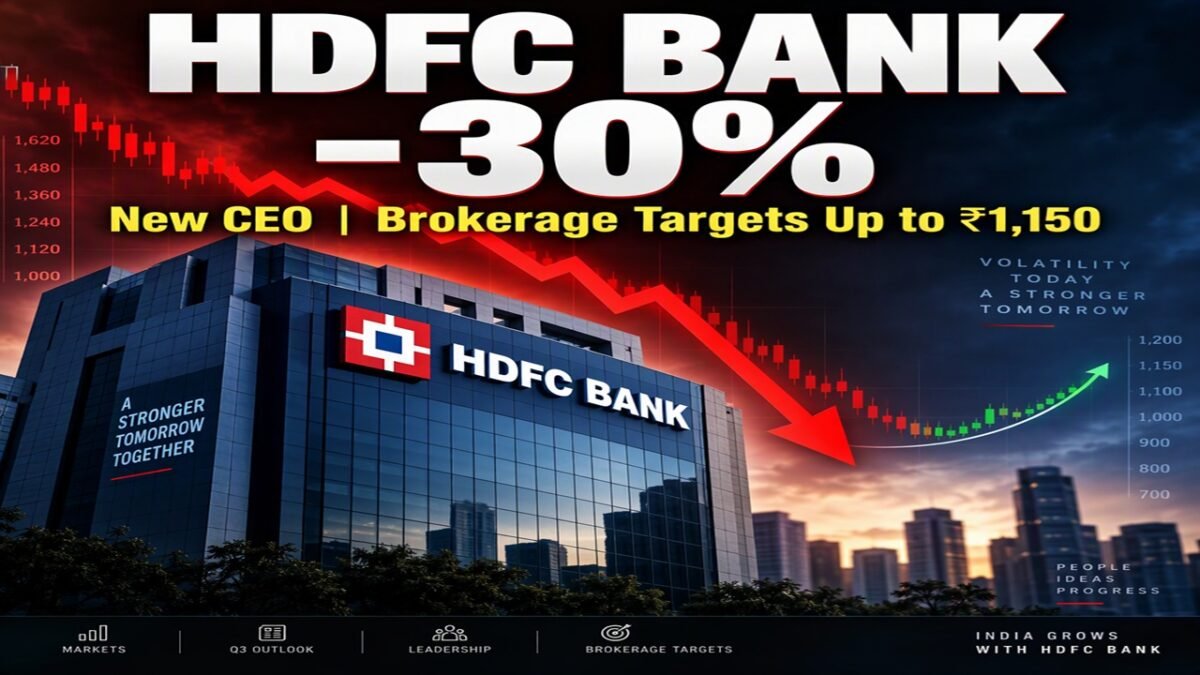
HDFC Bank, India’s largest private lender, has had a brutal 2026. The stock is down roughly 30% for the year, touching a 52-week low of ₹668.9 on October 28 before recovering slightly to close at ₹699.5 on November 2 . This is the bank’s worst calendar-year performance since 2008 .
For long-term investors who bought into the “HDFC Bank is a compounder” story, the question is uncomfortable but necessary: Is this a buying opportunity, or is something structurally broken?
What Went Wrong: Three Overlapping Problems
1. Leadership Turmoil That Shook Confidence
The trouble began in March 2026 when former chairman Atanu Chakraborty resigned abruptly, stating in his letter that “certain happenings and practices within the bank” were “not in congruence” with his personal values and ethics . The stock plunged 12% in four trading days, wiping out roughly $16 billion in investor wealth.
The uncertainty deepened in August when CEO Sashidhar Jagdishan announced he would not seek a second term. The simultaneous exit of the Chief Compliance Officer added to governance concerns .
2. The Post-Merger Hangover
HDFC Bank’s 2023 merger with parent HDFC Ltd nearly doubled its balance sheet overnight. But it also brought a large book of wholesale borrowings while the bank’s low-cost CASA deposits failed to keep pace. This forced the bank to rely on costlier deposits, structurally raising its cost of funds .
The result: net interest margins compressed to 3.16% on total assets in Q2 FY27, down from pre-merger levels . Profit growth has slowed to single digits—Q2 net profit rose just 4.7% year-on-year to ₹19,510 crore, meeting estimates but hardly inspiring .
3. Foreign Investors Stepped Back
Jefferies’ Christopher Wood exited HDFC Bank entirely from his portfolio, and foreign institutional holdings have been under pressure . The stock’s underperformance created a negative feedback loop: weak performance led to outflows, which further pressured prices.
The Turnaround Signal: Anup Bagchi Takes Charge
On October 27, 2026, Anup Bagchi officially became HDFC Bank’s new MD & CEO for a three-year term, succeeding Jagdishan .
Bagchi is not an HDFC insider. He spent over three decades at the ICICI Group, most recently as MD & CEO of ICICI Prudential Life Insurance. He previously served as Executive Director at ICICI Bank, overseeing retail, business, and rural banking .
Why this matters: The market hates uncertainty more than bad news. The prolonged succession question—who will lead the bank, and in what direction?—has now been answered. Emkay noted that Bagchi’s appointment “should bring an end to the prolonged succession uncertainty and help restore customer and investor confidence” .
The stock’s ADR rose about 5% in the first week of October when Bagchi’s appointment was announced , a sign that investors see the leadership clarity as a net positive.
What Brokerages Are Saying
Despite the gloom, most major brokerages remain bullish. The consensus view: the problems are cyclical and fixable, not structural.
| Brokerage | Rating | Target Price | Implied Upside* |
|---|---|---|---|
| Bernstein | Outperform | ₹1,150 | ~58% |
| Emkay | Buy | ₹1,050 | ~44% |
| Motilal Oswal | Buy | ₹925 | ~27% |
| ICICI Securities | Buy | ₹920 | ~26% |
| Jefferies | Buy | ₹880 | ~21% |
| Systematix | Buy | ₹875 | ~20% |
*Based on Q2 results and reports from October 2026
The bull case rests on three pillars:
-
Asset quality remains pristine. Gross NPA improved to 1.11% in Q2, down from 1.17% in the prior quarter. Credit costs are low at 44 basis points . This is not a bank with a bad loan problem.
-
Margins may be bottoming out. ICICI Securities noted that NIM “appears to be bottoming out” after the 8 basis point sequential decline . The bank expects improvement from here.
-
Valuation is undemanding. At 1.9x standalone book value, HDFC Bank trades at a significant discount to its historical premium and roughly 26% cheaper than ICICI Bank on a P/B basis .
The bear case: Margin recovery depends on CASA growth, which has been elusive. The credit-deposit ratio remains elevated at 96%, and the bank still trails systemic loan growth . A meaningful re-rating may not come until margins visibly bottom and earnings reaccelerate.
What Should Investors Do?
This is not a stock for traders looking for a quick bounce. The problems—deposit mobilization, margin pressure, and rebuilding institutional trust—will take multiple quarters to resolve.
But for investors with a 3-5 year horizon, the current price embeds a lot of pessimism. The bank’s asset quality is intact, its franchise is unmatched in scale, and the new CEO brings a credible outside perspective. The stock is a “patient compounder” story, as one analyst put it, not a near-term re-rating candidate .
The key things to watch in the next two quarters:
-
Whether NIM stabilizes or continues to slip
-
CASA ratio trajectory
-
Any strategic announcements from Bagchi on priorities
-
Whether FII outflows reverse
If margins bottom out and Bagchi articulates a clear path forward, the re-rating could be sharp. If not, the stock may stay range-bound for longer than bulls hope.
FAQ
Q1: Why did HDFC Bank shares fall so much in 2026?
Three factors converged: the abrupt resignation of chairman Atanu Chakraborty in March raised governance concerns, the post-merger balance sheet structure pressured margins, and foreign investors reduced exposure, creating a negative feedback loop .
Q2: Is HDFC Bank a good buy now?
Most brokerages rate it a Buy with targets ranging from ₹875 to ₹1,150. The bank’s asset quality is strong (GNPA 1.11%), and valuation is below historical averages. However, margin recovery and deposit growth remain concerns, so it suits investors with a medium-to-long term horizon .
Q3: Who is the new CEO of HDFC Bank?
Anup Bagchi, former MD & CEO of ICICI Prudential Life Insurance, took charge on October 27, 2026, for a three-year term. He spent over 30 years at the ICICI Group .
Q4: What was HDFC Bank’s Q2 FY27 profit?
Net profit rose 4.7% year-on-year to ₹19,510 crore, broadly meeting estimates. Net interest income grew 9.7% to ₹34,619 crore, while NIM stood at 3.16% on total assets .