Warren Buffett retired on December 31, 2025. But his advice on how to structure retirement income is getting more attention than ever—and for good reason.
Most retirement strategies are complicated. They involve Monte Carlo simulations, dynamic withdrawal rules, tax optimization layers, and enough jargon to make your head spin. Buffett’s approach, by contrast, fits on a single page. And according to the man who created the famous “4% rule,” it actually works.
The Core of Buffett’s Strategy
Buffett’s retirement advice, as outlined in his 2013 letter to Berkshire Hathaway shareholders, rests on a simple division of needs :
Essentials first: Cover your basic living expenses—housing, food, healthcare—with guaranteed income sources like Social Security and annuities. This is the foundation. You do not touch your investment portfolio for these costs.
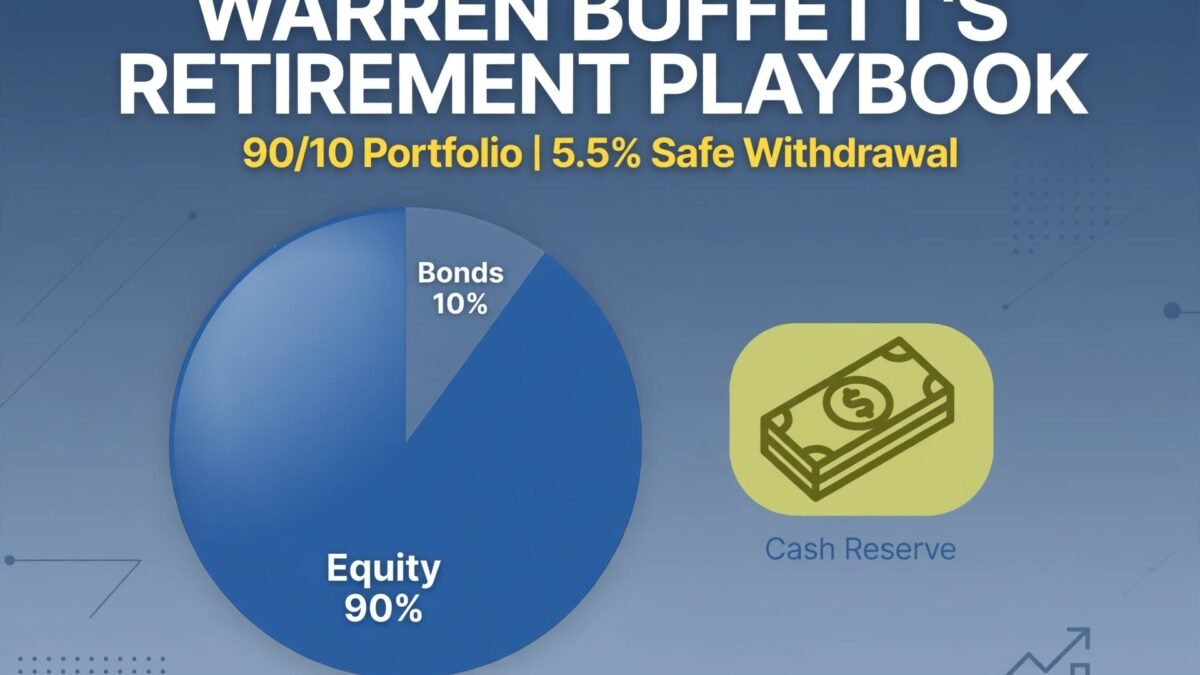
Discretionary spending from a portfolio: For everything beyond the essentials, Buffett recommends a portfolio split of 90% in a low-cost S&P 500 index fund and 10% in short-term government bonds .
The cash buffer: The strategy also calls for holding a cash reserve. Buffett has compared cash to oxygen—essential in an emergency, even if it is not a productive long-term asset. This cash buffer allows retirees to avoid selling stocks during bear markets .
Inflation adjustment: Like the classic 4% rule, the income rate is adjusted for inflation each year .
What the Father of the 4% Rule Says
Bill Bengen, the financial advisor who created the 4% rule in 1994, recently analyzed Buffett’s strategy. His verdict? A “roaring success” on a technical basis .
Bengen found that the safe portfolio spending rate for the Buffett strategy is approximately 5.5% to 5.8%—slightly lower than comparable inflation-adjustment strategies that allocate less to a cash buffer, but not by much. He described it as viable, though dynamic spending frameworks may be better at maximizing the safe starting spending rate outright .
“Not very surprising that the math works, given Warren Buffett’s reputation as a financial genius,” Bengen told Retirement Upside .
Why Some Advisors Are Skeptical
While the math checks out, practicing financial advisors have raised practical concerns.
The 15% cash allocation is too high for many retirees. Michael Walstedt, founding advisor of Reliant Wealth Advisory, told Yahoo Finance that retirees should hold about 12 months of cash reserves—not a fixed 15% of their portfolio. For someone with a $2 million portfolio, 15% cash means $300,000 sitting idle. “I would rather use short-term bond funds with attractive yields as the near-term spending bucket instead of that much idle cash,” said Herman Schroeder of Schroeder Capital Management .
Most families need growth, not just preservation. Chad Holmes, founder of Formula Wealth, pointed out a structural flaw in the “essentials covered by Social Security and annuities” assumption. “Saying people should just put most of their spending needs into guaranteed income sources assumes people don’t require much return in their portfolio,” he said. “Most families need risk in order to achieve returns simply to keep up with compounding inflation over a multidecade retirement” .
Annuities are a hard sell. Many retirees are unfamiliar with annuities or reluctant to lock up capital in them. Buffett’s strategy relies on them for the essentials layer, but adoption remains low .
The 90/10 Portfolio: Aggressive or Sensible?
The 90% equity allocation looks aggressive for a retiree. Traditional wisdom suggests moving toward bonds as you age. But Buffett’s reasoning is straightforward: retirement can last 30 years or more. Over that horizon, stocks have historically outperformed bonds, and a heavy equity allocation protects against the silent killer of retirement—inflation.
The 10% bond allocation and the cash buffer provide the stability needed to ride out downturns without selling stocks at the wrong time. It is a barbell approach: growth on one side, safety on the other.
For investors who cannot stomach a 90% equity allocation, the lesson is not necessarily to copy the exact percentages. It is to understand the principle: keep enough safe assets to avoid forced selling, and let the growth assets do their job over time.
Buffett’s Broader Retirement Principles
Beyond the portfolio math, Buffett has offered several retirement-adjacent principles that are just as important :
Pay off high-interest debt first. Buffett calls this the best guaranteed return available. Credit card interest compounds against you; paying it off is a guaranteed win.
Stay within your circle of competence. Invest in what you understand. For most retirees, that means broad index funds rather than individual stocks or unfamiliar trends.
Live below your means. Buffett still lives in the Omaha house he bought in 1958 for $31,500. Frugality preserves capital and reduces pressure on retirement savings.
Take care of yourself before your children. Buffett’s advice: leave children “enough so they can do anything, but not enough so they can do nothing.” Over-supporting adult children can jeopardize your own retirement security.
The Bottom Line
Buffett’s retirement strategy is not a magic formula. It is a disciplined framework built on three ideas: cover essentials with guaranteed income, hold enough cash to avoid panic selling, and let a low-cost equity portfolio grow over decades.
The father of the 4% rule says the math works. Some advisors say the cash allocation is too high and the annuity assumption is unrealistic for most families. Both can be true.
What matters for retirees is not copying Buffett’s exact percentages, but understanding the logic behind them: protect the downside so you never have to sell at the bottom, and let time and compounding do the rest.
FAQ
Q1: What is Warren Buffett’s retirement portfolio allocation?
Buffett recommends 90% in a low-cost S&P 500 index fund and 10% in short-term government bonds, plus a cash buffer for emergencies. Essentials should be covered by Social Security and annuities .
Q2: What withdrawal rate does Buffett’s strategy support?
Bill Bengen, creator of the 4% rule, found the safe spending rate for Buffett’s strategy is approximately 5.5% to 5.8%, adjusted for inflation .
Q3: Why do some advisors disagree with Buffett’s strategy?
Some argue the 15% cash allocation is too high and that most families need more portfolio growth than Buffett’s framework assumes. Annuities are also unfamiliar or unappealing to many retirees .
Q4: Is a 90% stock allocation too risky for retirees?
It depends on the individual. Buffett’s view is that retirement can last 30+ years, and stocks protect against inflation over that horizon. The cash and bond allocation provides a buffer against downturns. Conservative investors may prefer a lower equity allocation.
Q5: What is the most important lesson from Buffett’s retirement advice?
Protect against forced selling. Keep enough safe assets (cash, bonds, guaranteed income) so you never have to sell stocks during a market crash. Let the growth portion compound over time.
